Registration & licensing
FSSAI Licence Fees in 2026: Government Fee vs Professional Fee Explained
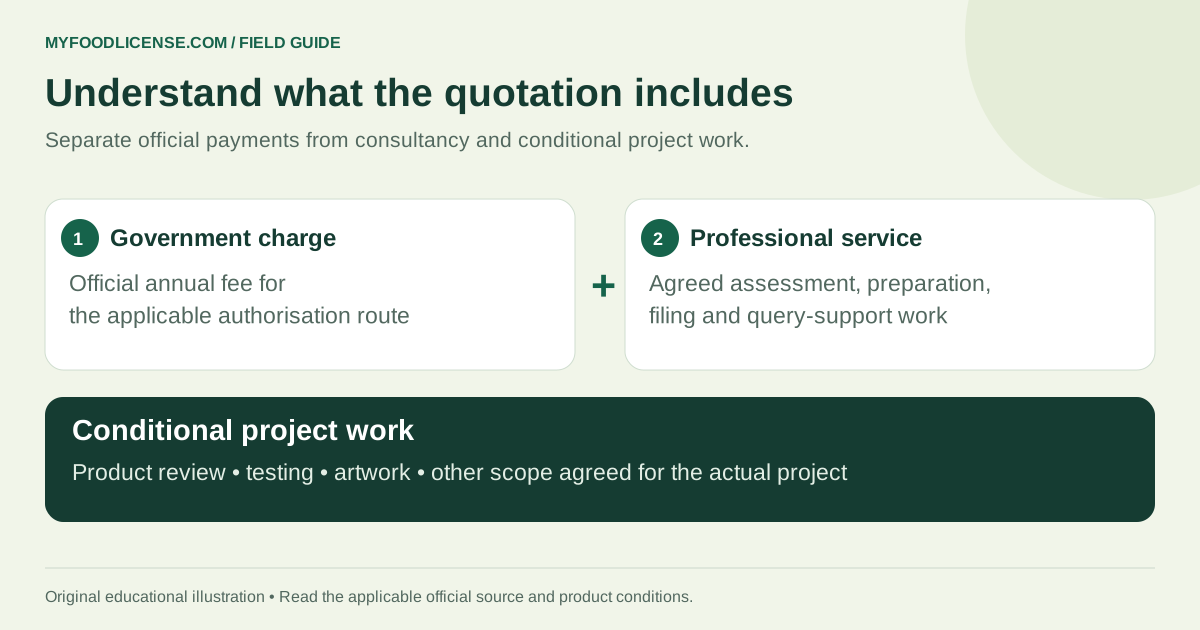
Separate the official government charge from the fee for consultancy work. FSSAI's 2026 framework provides perpetual validity, but the government fee remains an ongoing obligation; a service quotation should explain both parts of the cost.
By the MyFoodLicense team Sources checked 6 min read
In this guide
- Current government fees: the starting figures
- What perpetual validity means for cost planning
- What does the professional fee pay for?
- Additional work that may need its own budget
- How to compare two licence-service quotations
- Prepare the inputs that make a quote meaningful
- Keep payment evidence and monitor the account
- Download a preparation worksheet
- Frequently asked questions
- Official sources
Current government fees: the starting figures
The April 2026 official update reports the implemented fee structure. Read it alongside the applicable eligibility row and the live portal payment demand. The figures below are annual government charges, not quotations from myfoodlicense.com. Official April 2026 update.
| Route | Annual government charge | Budgeting note |
|---|---|---|
| Registration, ordinarily | ₹100 | Check fee-waiver or special registration rows. |
| State licence, ordinarily | ₹5,000 | Select the correct activity before estimating. |
| Central licence, ordinarily | ₹7,500 | Separate business licensing from product or import-clearance work. |
| Railways/Central Government agency Central licensing entries | ₹2,000 | Use the exact qualifying row; this is not the ordinary Central fee. |
The revised KoB table also shows waived registration fees for specified activities, including hawkers and Anganwadi centres. Eligibility for a waiver must be established from the applicable row rather than assumed from the business's size. Check the full fee and eligibility table.
When comparing this guide with an older webpage, check the source date and the selected activity. Historic State fee tiers or a total for a multi-year renewal may describe an earlier system. Save the current official row and the portal receipt with the cost approval so the basis is clear.
What perpetual validity means for cost planning
The March 2026 amendment removes periodic expiry from the revised framework while retaining annual fees and applicable returns. Specified failures can lead to deemed suspension. Do not interpret perpetual validity as a one-time payment buying unrestricted operation forever. Read amended regulation 2.1.7.
The implementation FAQ says fees can be selected for any number of years at once and paid at any time of year. It also describes adjustment of prepaid fees when the revised thresholds change eligibility. Read the official fee FAQ.
Build a budget that identifies the covered payment period and the next action shown in the account. Avoid inventing a universal payment deadline from a consultant's webpage. Reconcile the certificate, payment history and live FoSCoS status for the actual business.
Hypothetical arithmetic illustration
If the applicable annual government charge is ₹5,000 and the account permits payment for three years, the simple government-fee component is ₹15,000. This calculation excludes professional work and any other applicable charges. It illustrates multiplication, not a personalised payment demand.
What does the professional fee pay for?
A professional fee should buy identifiable work. Ask whether it includes selecting the application route, checking the papers, preparing entries, uploading documents, tracking progress and responding to questions. These stages require different amounts of effort depending on the business facts.
A simple application with consistent papers may need less preparation than a manufacturing file with unresolved classification and premises issues. A price comparison is useful only when the scope is comparable. A low initial quote can be incomplete if essential work is charged separately.
Ask the provider to describe the deliverables in writing. For example, “document review” should explain whether the provider merely checks that scans exist or examines their consistency with the applicant and activity. “Query handling” should explain the extent of support and what happens if a query reveals a different business model.
myfoodlicense.com provides State licence application assistance and Central licence application assistance. Request a scope matched to the business before treating the total as a finished budget.
Additional work that may need its own budget
Some projects involve work beyond business licensing. A new packaged-food brand may need product classification, formulation assessment, label review, testing or clarification of ingredient status. An importer also needs to plan the particular product and shipment. List those questions before assuming an application service includes them.
| Possible cost item | Question to ask |
|---|---|
| Product classification | Is the proposed food's regulatory route already established? |
| Formulation or ingredient review | Does the quote include evaluating the actual recipe and specifications? |
| Laboratory work | Which tests, samples and laboratory charges are within scope? |
| Artwork review | How many SKUs, pack sizes and revision rounds are covered? |
| Authority clarification | Which communications and response stages are included? |
| Premises preparation | Does the business need operational work outside the application service? |
This is a planning list, not a statement that every applicant must pay for every item. Mark each item as necessary, optional, already complete or awaiting assessment. That produces a more realistic budget than adding a generic “compliance package” to every application.
How to compare two licence-service quotations
Create a simple comparison sheet with the applicant, premises and activities at the top. Ask each provider to quote against those same facts. If one provider assumes a different KoB or excludes a site, investigate the difference before comparing prices.
- Separate government and professional amounts. Ask how the government payment will be acknowledged.
- Identify taxes and conditional costs. Ask what the total includes and what can change it.
- Define document preparation. Establish who obtains missing evidence and who corrects discrepancies.
- Define query support. Clarify the support included if the authority requests further information.
- Confirm access and handover. Decide how the business receives the application reference, receipts and final record.
- Review the service terms. Understand cancellation, refunds and additional-work charges before instructing the provider.
A proposal should not imply that a higher fee can buy official approval. Evaluate the explanation of the route and the quality of preparation. A good scope makes both the provider's work and the client's responsibilities visible.
Prepare the inputs that make a quote meaningful
Supply the business activity, legal structure, location, expected or relevant turnover information and proposed product range. Mention imports, online operations, contract manufacturing and additional premises if they are part of the plan.
Tell the provider whether documents are ready and whether there is an existing application or authority query. Share the actual query rather than a summary such as “documents rejected.” An accurate initial brief reduces the chance of pricing for the wrong task.
Keep a list of unresolved questions. If the product classification is unclear, ask whether the first engagement is an assessment or a complete filing. Separating those stages can make the work more reviewable and prevent a service fee from being mistaken for a guarantee.
Keep payment evidence and monitor the account
Maintain a cost record with the government acknowledgement, the professional invoice and any agreed additional work. Match each payment to the applicant and application reference. Do not rely only on a message saying “payment done.”
For an existing business, review the current account before paying for a service described as renewal. Establish whether the task concerns annual fees, transition, modification or another issue. The name used in a quotation should accurately describe the work being done under the current framework.
Use the category comparison to resolve eligibility and the document checklist to identify preparation work. Together they provide a stronger basis for a quotation than a turnover figure and an urgent request for the cheapest licence.
Download a preparation worksheet
Use this worksheet to organise the facts and evidence for the decisions described in this guide.
Frequently asked questions
Is the FSSAI government fee included in every consultant's price?
It depends on the written quotation. Ask for separate government and professional amounts, and check taxes and conditional charges.
Is an FSSAI licence free because validity is perpetual?
Perpetual validity does not remove annual government fee obligations. Check the applicable official row and the live account's payment position.
What is myfoodlicense.com's professional fee?
No professional rate is quoted in this guide. Request a scope-based proposal for the applicant, activity, premises and work required.
Can I prepay government fees for several years?
The March 2026 implementation FAQ describes an option to select fees for any number of years. Check the options and payment position in the actual account.
Does a licence-service quote cover label approval?
Check the scope. Business licensing and review of a product's label or claims are separate questions and may require separate work.
Official sources and further reading
Checked on 2 October 2026. Gazette notifications and operative directions prevail over compilations and summaries, including this guide.
- FoSCoS revised Kind-of-Business eligibility table, 2 April 2026 file: Activity-specific eligibility and annual fees. The PDF itself is marked updated 1 April 2026; relevant rows appear on pages 3, 6, 7 and 9.
- FSSAI monthly achievements: April 2026: Cross-check for updated fees and 10 April 2026 import-payment workflow. Official indexed PDF content was accessible although direct fetching was inconsistent.
- Licensing and Registration Amendment Regulations, notification dated 10 March 2026: Regulation 2.1.7: perpetual validity, annual fees, applicable returns and suspension; regulation 2.1.17: risk-based inspections.
- FSSAI implementation FAQs issued 27 March 2026: Operational guidance on fee prepayment, migration, unchanged licence numbers and licences issued on or after 1 April 2026.
- Official FoSCoS application portal: Official applications, help topics, current document lists and eligibility information.
This guide is general information, not legal advice; the right route depends on your product and business facts. Examples marked hypothetical are illustrations, not client cases. MyFoodLicense is an independent consultancy and is not affiliated with FSSAI; applications are decided by the competent authority on the official FoSCoS portal.