Registration & licensing
FSSAI Registration vs State Licence vs Central Licence: Which One Do You Need?
Use the revised 2026 turnover bands only after checking your business activity. Many ordinary activities follow the registration–State–Central progression, while several KoBs have their own licensing route regardless of turnover.
By the MyFoodLicense team Sources checked 6 min read
In this guide
- The 2026 comparison table
- The activity exceptions that change the answer
- How to choose the right category in practice
- Worked scenarios: the facts that matter
- How should existing businesses approach the 2026 transition?
- Does a Central licence automatically cover the whole business?
- Choose assistance by scope, after eligibility
- Download a preparation worksheet
- Frequently asked questions
- Official sources
The 2026 comparison table
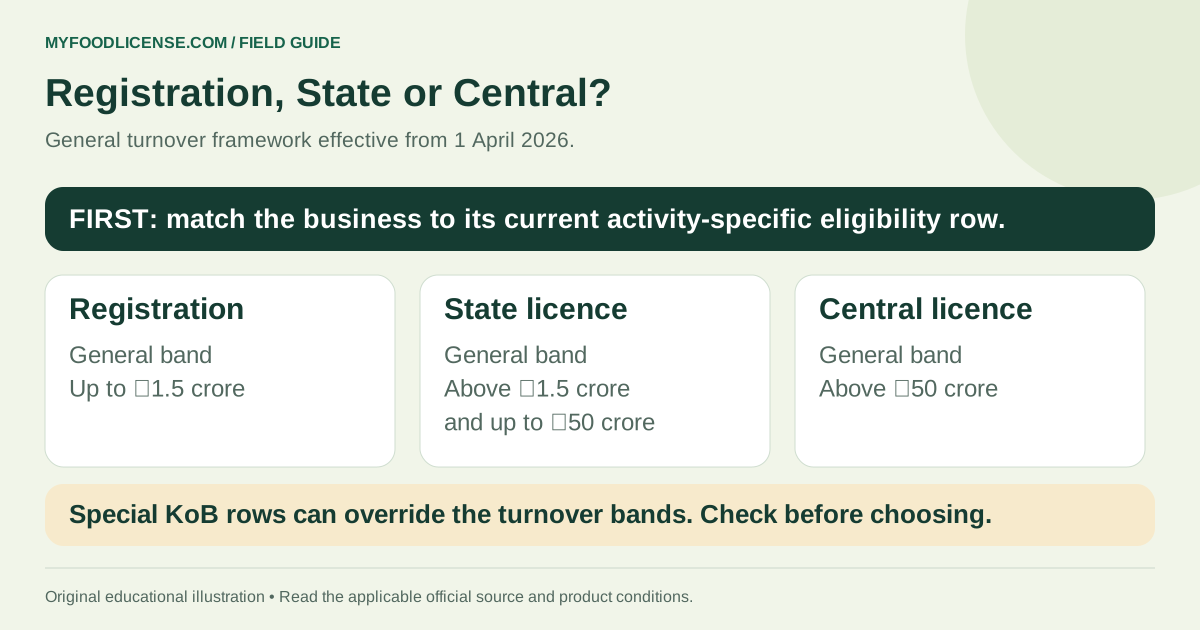
The turnover order is effective from 1 April 2026. The following table summarises its general bands; apply them through the detailed KoB eligibility table. Official turnover order.
| Category | General annual-turnover band | Decision to make first |
|---|---|---|
| Registration | Up to ₹1.5 crore | Does this activity permit registration? |
| State licence | Above ₹1.5 crore, up to ₹50 crore | Does a special KoB row override the band? |
| Central licence | Above ₹50 crore | Is Central licensing already mandatory for this activity? |
Think of the turnover bands as a sorting step after activity identification. They should not be used to decide that every business below the first boundary qualifies for registration. The distinction matters most when the business imports food, operates through a specialised manufacturing route or combines several functions.
The activity exceptions that change the answer
The revised table lists Importer, E-Commerce, proprietary-food manufacturing, supplements/nutraceuticals and non-specified foods under Central licensing without a turnover threshold restriction. A multi-state Head Office/Registered Office has a separate Central row. Clubs/canteens and caterers have distinct rows too. Check the complete April 2026 KoB table.
The practical lesson is to describe your role precisely. Selling through an online marketplace and operating an e-commerce food business are questions that need factual assessment. Record who owns the stock, who takes orders, who handles the food and which entity provides the platform. Do not jump from “I use the internet” to an unsupported licensing conclusion.
Similarly, “catering,” “home kitchen” and “restaurant” should not be treated as interchangeable labels. How meals are prepared, supplied and served can help establish the correct row. If the business fits an exception, document the row that applies instead of trying to fit it into a generic turnover calculator.
Check the original table: some rows have qualifications that disappear in short summaries. Where the route is unclear, ask for a written activity assessment before filing or purchasing a service package.
How to choose the right category in practice
Use a short decision worksheet. The aim is to make the conclusion reproducible: another person should be able to read your business description, identify the same issues and understand why the selected row fits.
- Identify the applicant. Record the legal entity or individual, rather than only the consumer-facing brand.
- Describe each premises. Note the address, the operation at the site and the entity responsible for it.
- List actual activities. Distinguish making food, repacking it, importing it, storing it and selling it.
- Review product classification. For a manufacturer, identify whether the proposed range belongs to a specialised product route.
- Read the matching KoB row. Check its exceptions before applying a turnover boundary.
- Confirm in the current FoSCoS application. Investigate a discrepancy instead of selecting a convenient alternative.
Give the worksheet a review date. Revisit it if the operation changes. A company that initially sells finished products may later start repacking; a local brand may later import an ingredient or launch a supplement range. Reusing the first conclusion without reviewing those changes can create a gap between the paperwork and the real business.
Worked scenarios: the facts that matter
Hypothetical scenario: a neighbourhood retailer
A shop sells sealed food products obtained from suppliers and reports annual turnover of ₹40 lakh. Begin with the retailer row and its registration eligibility. If the shop also starts repacking bulk foods under its own brand, reassess the added activity before assuming the original route still covers the full operation.
Hypothetical scenario: an importer with small sales
A new business proposes importing packaged snacks and expects ₹25 lakh in annual sales. The activity assessment comes before the turnover sorting step. Check the importer-specific route, and plan product and consignment compliance separately from the business authorisation.
Hypothetical scenario: a packaged-food manufacturer
A manufacturer expects ₹80 lakh in sales and describes its range as “innovative snacks.” The important missing information is the formulation and applicable product classification. Establish that first, then use the correct manufacturing row. The marketing description cannot establish eligibility by itself.
These examples show a method, not a regulatory determination for a reader's business. A useful assessment states its assumptions. If a missing fact could change the answer, make that fact an action item rather than concealing the uncertainty.
How should existing businesses approach the 2026 transition?
The implementation FAQ describes migration based on self-declarations, preservation of the existing number, no migration fee for the revised thresholds and adjustment of prepaid fees. Check the actual FoSCoS account for the transition position of your certificate. See the official migration FAQ.
Before making a declaration, collect the relevant business information and review whether the activity itself has changed. A reduction in expected eligibility category does not answer a question about a new product, another premises or an inaccurate activity entry. Keep those issues distinct in the work plan.
Save the certificate and account status before and after any transition action. This provides a reference when communicating with suppliers, marketplaces or internal teams. If different systems display conflicting information, investigate which document and status each system is using.
Does a Central licence automatically cover the whole business?
A Central licence should not be treated as a general pass for every entity, location and product associated with a brand. Review the actual certificate and the arrangements at each site. Map the manufacturing partner, brand owner, importer and warehouse where relevant.
For a company operating in several places, prepare a table with one row per location. Add the legal operator, the activities, the authorisation currently held and the questions requiring review. This is more useful than an inventory of certificate numbers without context.
If the brand uses a contract manufacturer, obtain the manufacturer details and describe the contractual responsibilities. The brand's commercial relationship with the factory should be understandable from the evidence. The factory's certificate does not, by itself, resolve every regulatory question for the brand.
Choose assistance by scope, after eligibility
Compare consultancy proposals against the work you need. A proposal should identify the applicant and site, the activity assessment, the document preparation, the filing support and the handling of queries. Ask what additional work would be charged if the first business description turns out to be incomplete.
myfoodlicense.com provides State licence application support and multiple-KoB assessment. The assessment is useful when the business combines functions or when a short turnover-based answer would leave important facts unresolved.
Once the route is agreed, use the document preparation guide and the government-versus-professional fee guide to prepare the application. This keeps category selection, evidence and cost planning connected without allowing the cheapest quotation to decide the legal route.
Download a preparation worksheet
Use this worksheet to organise the facts and evidence for the decisions described in this guide.
Frequently asked questions
What is the FSSAI registration turnover limit in 2026?
The general revised band is turnover up to ₹1.5 crore, effective from 1 April 2026. Check whether the activity-specific KoB row permits registration.
Can a low-turnover importer use basic registration?
Check the importer row, which has a Central licensing route irrespective of turnover. A small sales forecast does not settle importer eligibility.
Is exactly ₹1.5 crore inside the registration band?
The general registration band includes ₹1.5 crore. State licensing starts above that amount, subject to the applicable activity row.
Is exactly ₹50 crore inside the State band?
The general State band includes ₹50 crore. The Central turnover band begins above it, subject to activity-specific requirements.
Can I decide from turnover alone?
Start with the actual activities, product route and premises. Use turnover only after checking the matching official eligibility row.
Official sources and further reading
Checked on 2 October 2026. Gazette notifications and operative directions prevail over compilations and summaries, including this guide.
- FSSAI order dated 13 March 2026: revised turnover thresholds: Turnover bands and their 1 April 2026 implementation date. Read with the detailed KoB eligibility table.
- FoSCoS revised Kind-of-Business eligibility table, 2 April 2026 file: Activity-specific eligibility and annual fees. The PDF itself is marked updated 1 April 2026; relevant rows appear on pages 3, 6, 7 and 9.
- FSSAI implementation FAQs issued 27 March 2026: Operational guidance on fee prepayment, migration, unchanged licence numbers and licences issued on or after 1 April 2026.
- Official FoSCoS application portal: Official applications, help topics, current document lists and eligibility information.
This guide is general information, not legal advice; the right route depends on your product and business facts. Examples marked hypothetical are illustrations, not client cases. MyFoodLicense is an independent consultancy and is not affiliated with FSSAI; applications are decided by the competent authority on the official FoSCoS portal.