Registration & licensing
FSSAI Licence & Registration in 2026: The Complete Guide
A food business must identify the correct FSSAI registration or licence for its activity and premises before operating. In 2026, start with your Kind of Business, then apply the revised turnover rules; turnover alone does not settle every application.
By the MyFoodLicense team Sources checked 9 min read
In this guide
- What changed in FSSAI licensing in 2026?
- Describe the business before choosing a licence
- Registration, State licence and Central licence: how to approach the choice
- Prepare a consistent application file
- Apply through the official FoSCoS portal
- Handle queries with an evidence-based reply
- What should you do after the certificate is issued?
- Download a preparation worksheet
- Explore the detailed guides
- Frequently asked questions
- Official sources
What changed in FSSAI licensing in 2026?
The turnover order effective from 1 April 2026 places eligible businesses into these bands: registration up to ₹1.5 crore; State licence above ₹1.5 crore and up to ₹50 crore; Central licence above ₹50 crore. These are a starting framework. Match them to the current activity-specific eligibility row before deciding. Read the official turnover order.
The March amendment also introduced perpetual validity. It preserves annual fee and applicable return obligations, with deemed suspension for specified failures. A perpetual certificate still needs active compliance management. See amended regulation 2.1.7.
For an owner planning a new venture, these changes alter the sequence of decisions. A saved quotation, a friend's application or an old calculator may describe a different framework. Begin with today's business facts and today's official eligibility information. Keep a dated copy of the row you relied on in your application folder.
Start here: Compare registration, State licence and Central licence for the eligibility table and activity exceptions. Read the 2026 fee guide for government charges and professional-service costs.
Describe the business before choosing a licence
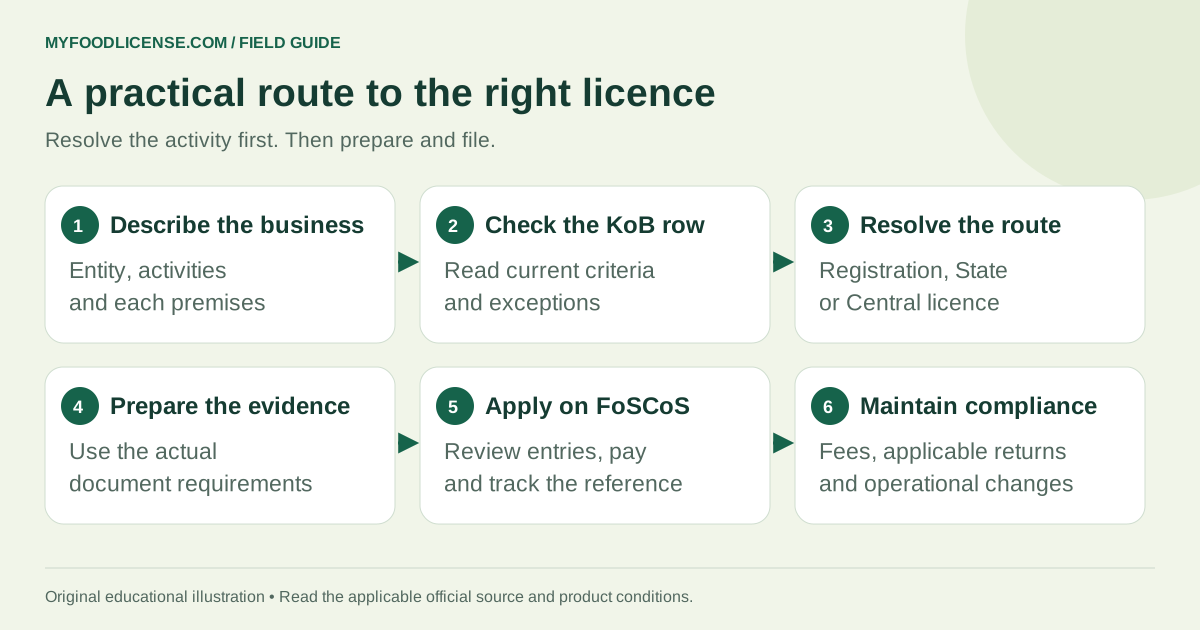
Write a short operational description in ordinary language. Explain what arrives at the premises, what your team does to it, what leaves, and who buys it. “We sell snacks” is incomplete if the same site also manufactures, repacks and stores them. This description is a practical planning tool, rather than a substitute for the application's formal entries.
List every location that participates in the business. Include a production kitchen, a storage site and an administrative office if relevant. Add the legal entity responsible for each location. This helps reveal situations where the brand name, leaseholder and applicant are different people or entities.
Next, map the description to the Kind of Business, often shortened to KoB. Product classification is a separate question: it concerns what the food is and which product rules apply. Resolve both questions before preparing a manufacturing application. A well-written activity description cannot repair an unsupported product classification.
For a proposed packaged-food range, collect the formulations early. Avoid deciding the route from the front label alone. A name such as “wellness drink” says little about the underlying ingredients, intended consumers or product presentation. The product-classification guide explains the difference between standardised, proprietary and non-specified routes.
Registration, State licence and Central licence: how to approach the choice
Check the official table from the top of the relevant business section. Read the complete row, including exceptions and fees. The current table identifies some activities that require a Central licence irrespective of turnover, including importing and certain specialised manufacturing activities. Use the revised KoB eligibility table.
Document the reasoning in one sentence: “The applicant carries out this activity at this premises, so this row applies.” Then record the evidence supporting any turnover declaration. This creates a useful explanation for colleagues, a consultant or a later reviewer.
If more than one activity occurs at the site, list all of them before filing. Ask whether the application reflects the full operation. If several states or legal entities are involved, create a location-and-entity map rather than treating the organisation as one undifferentiated business.
Once the route is established, scope the assistance you need. myfoodlicense.com offers registration assistance and Central licence application support. A useful engagement should explain the selected activity, the document work and the treatment of authority queries.
Prepare a consistent application file
Use an application folder with separate sections for applicant identity, business constitution, premises, activities and products. The exact upload list depends on the selected route and KoB; the document checklist explains how to assemble it without collecting every document mentioned online.
Check consistency before converting files into upload formats. The applicant's legal name should be traceable through the supporting papers. The premises description should be understandable from the address evidence. A product list should reflect the range actually proposed, with clear names rather than unexplained internal codes.
Make a small discrepancy log. For example, one document may use a shortened company name, another may show a previous address, and a landlord's document may identify a larger building than the occupied unit. Resolve the difference or prepare a truthful explanation and supporting evidence. Merely renaming the files does not solve the underlying mismatch.
Keep the original documents alongside the upload copies. Where a scan has several pages, verify that none are missing and that the signatures are readable. Avoid editing official evidence to make it appear consistent. If the evidence is wrong, correct it through the appropriate issuer or obtain the right supporting document.
Apply through the official FoSCoS portal
Use foscos.fssai.gov.in for official applications and current help material. Before entering details, have your activity assessment and document folder ready. Work through the portal's current prompts rather than relying on screenshots from an older guide.
- Select the location and activity. Reconcile the displayed eligibility with the route you identified from the current official table.
- Complete the applicant and premises information. Compare each entry with the underlying evidence before continuing.
- Add the relevant product information. For manufacturing activities, use the classification work prepared earlier.
- Upload the requested documents. Check the current file-format and size instructions shown beside each upload field.
- Review the declaration and payment. Read what you are declaring and save the government payment acknowledgement.
- Preserve the application reference. Keep the submitted version and monitor the account for further action.
These are planning stages, not a promise that every application uses identical screens or receives immediate approval. The consultant can prepare and support the application; the competent authority handles the regulatory decision.
Handle queries with an evidence-based reply
If the application is returned for clarification, read the complete query before uploading replacements. Break it into separate questions and match each one to a response and a document. This makes it easier to see whether you have actually addressed the concern.
A practical reply table contains the authority's issue, your factual explanation, the corrective action and the document filename. If the officer asks about the premises, a revised product list is unlikely to answer that question. If a formulation raises a classification problem, repeating the product's marketing name will not resolve it.
Record the deadline shown in the actual communication and portal. Do not assume that a deadline recalled from another application applies. Where the requested change affects the business itself, agree the facts internally before making declarations to the authority.
Hypothetical example
A snack brand rents a kitchen in one entity's name but starts an application under another. Its first preparation task is to establish and document the applicant's right to use the premises. The example illustrates a consistency check; it does not predict how a particular authority will decide an application.
What should you do after the certificate is issued?
Read the issued certificate against the submitted business description. Store it with the application's evidence and receipts. Share the relevant details with the team responsible for labels, procurement, operations and sales so that the approved information is used consistently.
Build an operating calendar with an owner for each task. Include the account's fee position, applicable returns, review of changes to the premises or product range, and the food-safety work relevant to the operation. The 2026 FAQ explains fee prepayment and migration arrangements; check the live account before assuming an older certificate has completed its transition. Read the implementation FAQ.
Review later amendments as well. The June 2026 licensing amendment expressly distinguishes manufacturing record requirements from non-manufacturing businesses. A generic checklist should therefore be tailored to your operation. Read the June amendment.
Finally, treat a new product, new facility or changed business model as a trigger for reassessment. Keep a change log that records what changed, who reviewed it and whether an application or other action is needed. This gives the business a workable way to maintain its regulatory position as it grows.
Download a preparation worksheet
Use this worksheet to organise the facts and evidence for the decisions described in this guide.
Download the preparation worksheet
Explore the detailed guides
Use these focused articles to work through the decisions relevant to your business.
- FSSAI Registration vs State Licence vs Central Licence: Which One Do You Need?
- Documents Required for FSSAI Registration and Licence: A Practical Checklist
- FSSAI Licence Fees in 2026: Government Fee vs Professional Fee Explained
- How to Apply for an FSSAI Licence on FoSCoS: Step by Step
- FSSAI Licence Renewal in 2026: Perpetual Validity, Annual Fees and Legacy Certificates
- FSSAI Registration for Home Bakers and Home Kitchens
- FSSAI Licence for Cloud Kitchens (Swiggy & Zomato Requirements)
- FSSAI Licence for Restaurants, Cafés and Caterers
- FSSAI Licence for E-commerce and Online Food Sellers (Amazon, Flipkart, Quick Commerce)
- FSSAI Licence for Food Importers: Central Licence, IEC and Process
- FSSAI Licence for Food Manufacturers: 2026 Eligibility, Categories and Documents
- FSSAI Licence for Exporters: Do You Need One?
- Kind of Business (KOB) on FoSCoS Explained and How to Pick the Right One
- Running Several Kinds of Business Under One Licence
- Multi-State Operations: Head Office Licence and Branch Licences
- How to Modify an FSSAI Licence: Adding Products, Changing Address or Capacity
- FSSAI Application Reverted or Rejected? How to Respond
- Change of Ownership, Partners or Company Name on an FSSAI Licence
- How to Surrender or Close an FSSAI Licence
- FSSAI for Retailers, Kirana Stores, Distributors and Wholesalers
- FSSAI for Warehouses, Cold Storage and Transporters
- FSSAI for Repackers and Relabellers
- FSSAI for Street Food Vendors, Hawkers and Seasonal Businesses
- Tatkal FSSAI Licence and Registration: Who Qualifies?
- How to Check Whether an FSSAI Licence Number Is Valid
- Penalty for Running a Food Business Without an FSSAI Licence
- FSSAI Annual Return (Form D-1): Who Must File and By When
- FSSAI Licence for Tiffin Services, Mess and Canteens
Frequently asked questions
Is FSSAI registration the same as a State licence?
They are different authorisation categories. Determine the applicable category from your activity and the current official eligibility criteria; the comparison guide linked above explains the 2026 framework.
Can I choose the cheapest category when starting a business?
Choose the category that fits the business facts and the applicable KoB row. Price should be assessed after eligibility has been established.
Does perpetual validity mean no future payments?
No. The March 2026 framework retains annual fee obligations and applicable return requirements. Check the live FoSCoS account's payment position and instructions.
Can a consultant guarantee an FSSAI licence?
A consultant can help assess, prepare and respond to queries. The competent authority makes the regulatory decision; myfoodlicense.com does not guarantee approval.
Which portal should I use to apply?
Use the official FoSCoS portal. The consultancy website provides assistance and information.
Official sources and further reading
Checked on 2 October 2026. Gazette notifications and operative directions prevail over compilations and summaries, including this guide.
- FSSAI order dated 13 March 2026: revised turnover thresholds: Turnover bands and their 1 April 2026 implementation date. Read with the detailed KoB eligibility table.
- FoSCoS revised Kind-of-Business eligibility table, 2 April 2026 file: Activity-specific eligibility and annual fees. The PDF itself is marked updated 1 April 2026; relevant rows appear on pages 3, 6, 7 and 9.
- Licensing and Registration Amendment Regulations, notification dated 10 March 2026: Regulation 2.1.7: perpetual validity, annual fees, applicable returns and suspension; regulation 2.1.17: risk-based inspections.
- FSSAI implementation FAQs issued 27 March 2026: Operational guidance on fee prepayment, migration, unchanged licence numbers and licences issued on or after 1 April 2026.
- Licensing amendment notified 23 June 2026: Changes to manufacturing production records and stock-rotation provision. Avoid extending manufacturing record requirements to all businesses.
- Official FoSCoS application portal: Official applications, help topics, current document lists and eligibility information.
This guide is general information, not legal advice; the right route depends on your product and business facts. Examples marked hypothetical are illustrations, not client cases. MyFoodLicense is an independent consultancy and is not affiliated with FSSAI; applications are decided by the competent authority on the official FoSCoS portal.