Registration & licensing
FSSAI Licence for Food Manufacturers: 2026 Eligibility, Categories and Documents
For food manufacturing in 2026, start with the current manufacturing KoB row and product route. Old production-capacity thresholds copied from earlier guides can give the wrong result. The revised table uses turnover for many activities and retains special rules for particular products and operations.
By the MyFoodLicense team Sources checked 3 min read
In this guide
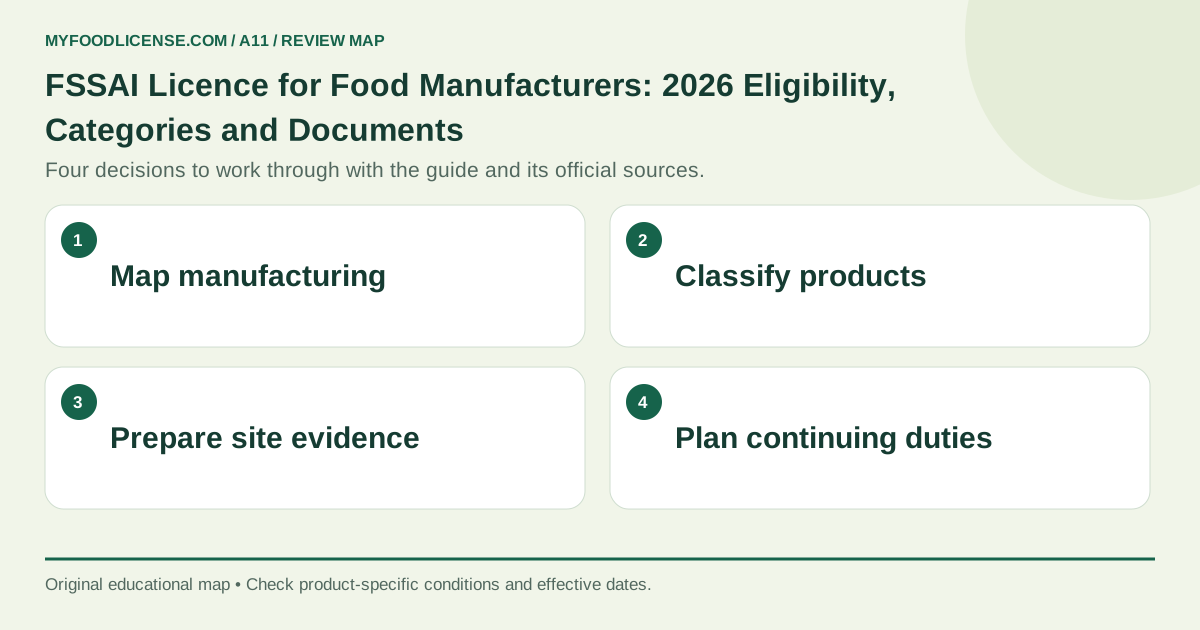
Map the factory’s operations
Record the premises, processes, equipment, products and actual manufacturing arrangement. Processing, repacking and relabelling are different activities even when finished packs look similar. Establish whether the applicant owns production, commissions another factory or handles bulk product locally.
Read the revised eligibility row
The April 2026 table must govern the route assessment. Many ordinary manufacturing rows now use revised turnover bands. Proprietary foods, health supplements and nutraceuticals, non-specified foods, Ayurveda Aahara and other listed specialised activities have Central requirements without a turnover restriction. Milling and export operations also need their own row review. Current manufacturing criteria.
Classification comes before the product list
Check whether each product meets a food standard, belongs to a specialised category or needs approval. A food-category code helps identify applicable provisions but does not establish that the recipe is legal. Keep the classification decision and ingredient evidence with the list submitted for endorsement. Use the classification guide.
Prepare site and technical evidence
Follow the live KoB document requirements for constitution, layout, equipment, premises and applicable technical or water evidence. Define the process flow and hygiene controls before treating the application as a document-upload exercise. Required evidence should describe the same facility that officers would inspect.
Plan post-licence duties
Build systems for batch traceability, testing, appropriate production records and annual returns. The June 2026 amendment changes particular licence conditions, including manufacturing-related records. Check the actual scope of each condition rather than imposing every factory requirement on every trader. June 2026 amendment.
A worked example
Hypothetical example
A manufacturer uses a dated calculator based on tonnes per day, then adds a proprietary snack to its product list. Reviewing the 2026 table and product route changes the licensing assessment. The owner updates the proposed application, while keeping capacity data for the facility evidence where it remains relevant.
Your practical checklist
- Map manufacture, processing, repacking and relabelling.
- Use the revised KoB criteria.
- Identify specialised products and exceptions.
- Prepare classification and formulation records.
- Match layout and technical evidence to the site.
- Set up testing, traceability and return records.
Download this preparation checklist
For help applying this review to your business, explore our State FSSAI Licence – New service. Bring the documents described above so the consultation can focus on the decisions still unresolved.
Frequently asked questions
Is production capacity irrelevant now?
It can remain relevant to site and technical assessment. Do not use obsolete capacity thresholds to select the licence route.
Do proprietary manufacturers need Central licensing?
The current table lists proprietary-food manufacturing under Central licensing irrespective of turnover.
Can one factory make several categories?
Assess the endorsed products, applicable conditions and each manufacturing activity.
Does an endorsed product list prove recipe compliance?
No. Ingredient, additive, standard and claim compliance require their own review.
What records should I prepare?
Use the applicable licence conditions and product risks to plan production, supplier, testing and distribution records.
Official sources and further reading
Checked on 2 October 2026. Gazette notifications and operative directions prevail over compilations and summaries, including this guide.
- FoSCoS revised Kind-of-Business eligibility table, 2 April 2026 file: Activity-specific eligibility and annual fees. The PDF itself is marked updated 1 April 2026; relevant rows appear on pages 3, 6, 7 and 9.
- Food Products Standards and Food Additives: regulation 2.12, Proprietary Food: Definition, exclusions, permitted ingredients, additive categories and the prohibition on treating a failed standardized product as proprietary.
- Licensing amendment notified 23 June 2026: Changes to manufacturing production records and stock-rotation provision. Avoid extending manufacturing record requirements to all businesses.
This guide is general information, not legal advice; the right route depends on your product and business facts. Examples marked hypothetical are illustrations, not client cases. MyFoodLicense is an independent consultancy and is not affiliated with FSSAI; applications are decided by the competent authority on the official FoSCoS portal.