Product classification & approvals
Standardised, Proprietary or Non-Specified Food? A Guide to FSSAI Product Classification
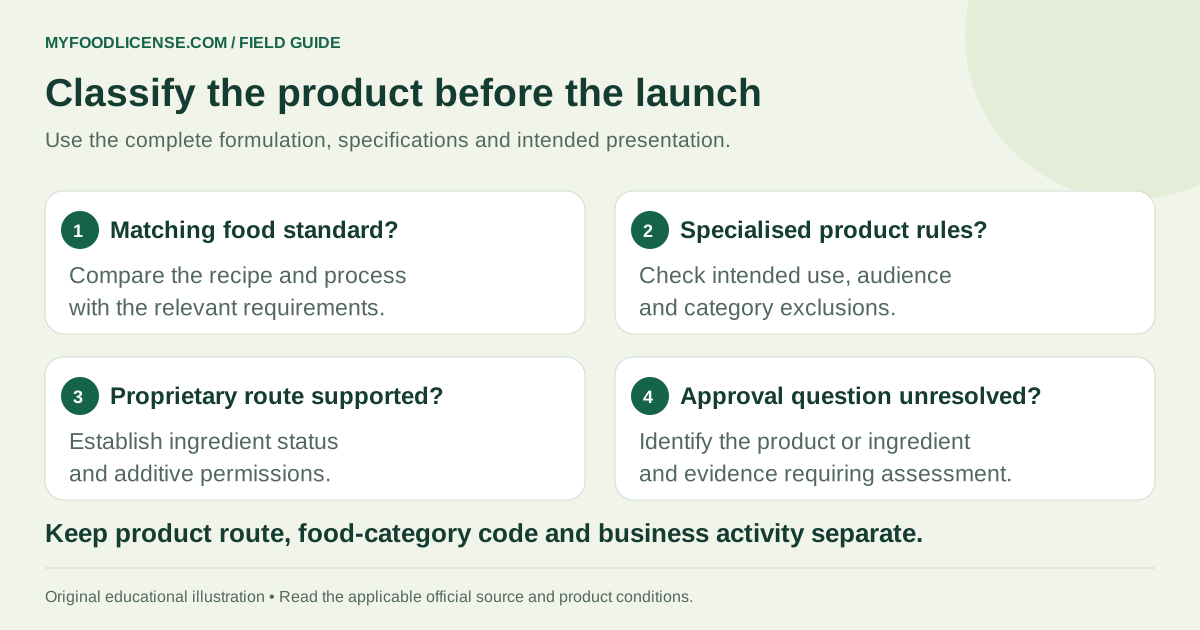
Classify the actual formulation and intended use before selecting a manufacturing route or finalising the label. A food without a matching product standard is not automatically non-specified, and an ingredient without a clear permitted-use basis cannot simply be assumed acceptable in proprietary food.
By the MyFoodLicense team Sources checked 8 min read
In this guide
- Three questions that product classification should answer
- When a product has a matching food standard
- What proprietary food means—and its limits
- What makes a non-specified-food approval question?
- Specialised regulations can change the classification
- What should a regulatory feasibility file contain?
- How approval, licensing and artwork fit together
- Common assumptions to challenge before launch
- Download a preparation worksheet
- Use the current approval channel
- Explore the detailed guides
- Frequently asked questions
- Official sources
Three questions that product classification should answer
A classification assessment should explain which product rules apply, how the ingredients and process fit those rules, and what further approval questions remain. It should also record the facts used to reach the conclusion.
Start with the final formulation, rather than a short brand description. Collect the complete components of blends, coatings, flavour systems and other compound ingredients. Record the intended consumers, use instructions, proposed claims and the process used to make the product.
Keep three concepts separate in the working file. The product route concerns what the food is. A food-category code helps identify applicable provisions such as additive permissions. A Kind of Business describes the operator's activity. Choosing one of them does not automatically establish the other two.
The official regulations directory provides product standards, specialised regulations, amendments and reference compilations. Use it to build the source set relevant to the actual product.
When a product has a matching food standard
Identify a candidate standard and compare it with the product's formulation, identity, process and relevant parameters. Avoid matching solely on a familiar word in the product name. A standards review should be specific enough for another reviewer to understand the comparison.
Make a table with the standard's relevant requirements in one column and the product evidence in the other. Mark where evidence is missing or a formulation change might be necessary. This converts a broad question—“Does the product comply?”—into a set of checkable issues.
Consider the intended name after assessing the standard. If the team has committed commercially to a name before the comparison is complete, document whether that decision constrains development. Resolve the product question before investing in printed packaging that may need changing.
Hypothetical standards review
A developer calls a new spread “jam” because that is the sales team's preferred name. The reviewer first checks the candidate standard and the recipe. If a parameter does not fit, the team must assess the product and naming options; it should not assume a different filing category erases the discrepancy.
What proprietary food means—and its limits
Regulation 2.12 addresses foods without a specified product standard, with exclusions for specialised categories. It restricts ingredient and additive use and says deviation from a standardised food's quality parameters does not make the result proprietary. Read regulation 2.12.
A proprietary-food assessment should therefore establish more than the absence of an exact standard. Assess the product against specialised regulations, then examine the permitted-use basis for the ingredients and the relevant additive category.
The regulation allows specified ingredient routes, including relevant standardised/permitted ingredients and the referenced Indian Food Composition Tables route, subject to qualifications. Its additive provisions depend on the food category or subcategory. Check the exact basis for each component. See the current proprietary-food extract.
Prepare an ingredient-status table with the ingredient identity, specification, intended level, source provision and conclusion. If the reviewer cannot establish the status, mark the item for further work. “Our supplier sells it” is a commercial fact, not a complete regulatory basis.
myfoodlicense.com offers proprietary-food assessment and detailed classification review. Supply the formulation and specifications so the assessment can address the product's actual composition.
What makes a non-specified-food approval question?
The non-specified regulations provide for prior approval before manufacturing or importing foods or ingredients within that route. The definition distinguishes these from proprietary food, and the procedure includes safety assessment. Read the non-specified-food regulations.
A novel ingredient or process can raise questions even if the surrounding food looks familiar. Conversely, a creative combination of ordinary ingredients does not automatically make the product novel. Establish the ingredient, specification, process and intended use before assigning a route.
Ask what is new in concrete terms: the source material, extraction process, composition, organism, intended use or another characteristic. This helps the reviewer determine which evidence and regulatory checks are needed.
Hypothetical ingredient assessment
A drink developer proposes a concentrated botanical extract described by its supplier only as “food grade.” The working file asks for the precise botanical identity, plant part, extraction information, specification and proposed use level. Without those facts, neither ingredient status nor the appropriate product route can be settled responsibly.
Do not interpret this example as a finding that every botanical extract requires prior approval. It illustrates the missing information a reviewer needs before assessing the actual ingredient.
Specialised regulations can change the classification
Investigate whether the product falls under a specialised regime before attempting a proprietary route. The exclusions in regulation 2.12 specifically matter for areas such as supplements and particular nutritional uses. Check the exclusions.
The intended use and presentation can be important evidence. Collect the front-pack copy, serving instructions, intended audience and proposed benefit statements. A formulation file without the proposed consumer use may leave a crucial classification question unanswered.
For a product that sits near a category boundary, create a classification memo recording the plausible routes and why one is supported. State the assumptions. If the conclusion depends on changing the product's claim or presentation, ensure the actual artwork reflects that decision.
The food route should also be assessed where medicinal positioning is proposed. Resolve the relevant regulatory boundary using the product facts and the appropriate specialised rules before a food-brand launch proceeds.
What should a regulatory feasibility file contain?
Prepare the information below before asking for a classification review. It is an original briefing checklist designed to make the assessment usable and reduce guesswork.
- A complete recipe with use levels and compound-ingredient components.
- Supplier specifications identifying ingredients beyond trade names.
- A clear manufacturing-process description.
- The intended audience, serving instructions and use conditions.
- The proposed name, claims and complete pack concept.
- Available evidence about product composition and safety.
- A list of uncertain ingredients or formulation decisions still open.
A feasibility review is especially useful while the team can still change the formulation. Record whether the product is ready for a regulatory conclusion or whether a small information gap prevents it. The result should be a decision and action list, not merely a stack of source links.
How approval, licensing and artwork fit together
Where the non-specified route applies, the regulations sequence approval and subsequent licence application. Product approval does not replace business licensing, and business licensing does not answer every product-approval question. See the approval-to-licensing provision.
The revised 2026 KoB table separately identifies proprietary-food, supplement and non-specified manufacturing routes. Link the completed product assessment to the licence activity assessment. Read the applicable manufacturing rows.
Use milestones for the launch: classification conclusion, formulation decision, approval decision where needed, licensing assessment and artwork sign-off. Keep each milestone's evidence. This makes it possible to explain why the team considered the product ready for the next step.
If prior approval is needed, budget for dossier preparation, missing evidence, questions and possible revisions. Avoid promising one universal completion time. The work depends on the specific product, evidence and review process. Confirm the current application channel and operative instructions before submission.
Common assumptions to challenge before launch
“It is permitted overseas.” Record the foreign status as background evidence, then assess the Indian basis and intended use. An overseas sale does not complete the domestic review.
“The supplier calls it natural.” Obtain an identity and specification. The term describes a supplier's presentation and does not establish all product or ingredient permissions.
“We can change the category if a parameter fails.” Investigate the standard, the reason for the discrepancy and the rules on proprietary food. A filing label should reflect the correct product assessment.
“The certificate proves the label is fine.” Review the artwork and claims separately using the completed product file. The classification conclusion should guide those reviews, not replace them.
Once the route is settled, use the packaged-food labelling guide and the claims guide to take the same facts into packaging and marketing. That keeps the product's legal identity consistent from development through sale.
Download a preparation worksheet
Use this worksheet to organise the facts and evidence for the decisions described in this guide.
Download the preparation worksheet
Use the current approval channel
The 6 May 2026 ePAAS order requires the specified prior-approval applications through that system from 1 June 2026. It covers relevant non-specified foods, claims and specialised product routes. Read the current form and dossier requirements rather than using a legacy email or offline submission instruction. Read the official order.
Explore the detailed guides
Use these focused articles to work through the decisions relevant to your business.
- Standardised vs Proprietary Food: What's the Difference?
- FSSAI Food Category System Explained (with Examples)
- Non-Specified Food and Novel Ingredient Approval: Process, Time and Cost
- Is This Ingredient Allowed in India? How to Check an Ingredient's Status
- Food Additives in India: Permitted Lists and Maximum Levels
- Can You Use This Product Name? FSSAI Rules on Naming Food
- Flavours on Food Labels: Natural, Nature-Identical and Artificial
- Fortified Foods and the +F Logo
- Organic (Jaivik Bharat) and Vegan Logos: How to Get Endorsement
- Millet Products: Standards and Labelling
- When Your Recipe Doesn't Comply: Reformulating Without Losing the Product
Frequently asked questions
Does every product without an FSSAI standard need product approval?
No single answer follows from the absence of an exact standard. Assess proprietary-food eligibility, specialised categories and any ingredient or non-specified approval questions.
Can a non-compliant standardised food be filed as proprietary?
Regulation 2.12 says deviation from a standardised food's quality parameters does not make the resulting product proprietary. Review the actual standard and discrepancy.
Is a food-category code the same as product approval?
A category code and a prior approval decision serve different purposes. Record the product route, additive category and licensing activity separately.
Is food grade enough to establish ingredient permissibility?
Obtain the ingredient's identity, specification, intended use and regulatory basis. The supplier's description alone does not complete that assessment.
Can myfoodlicense.com promise a fixed approval time?
A meaningful estimate needs assessment of the product, available evidence and required work. The authority controls the regulatory decision.
Official sources and further reading
Checked on 2 October 2026. Gazette notifications and operative directions prevail over compilations and summaries, including this guide.
- Food Products Standards and Food Additives: regulation 2.12, Proprietary Food: Definition, exclusions, permitted ingredients, additive categories and the prohibition on treating a failed standardized product as proprietary.
- Approval for Non-Specified Food and Food Ingredients Regulations, compendium dated 14 October 2022: Prior approval, application evidence and sequence of product approval followed by licensing. No universal approval-time promise.
- FSSAI FAQs on non-specified foods and ingredients, 6 May 2020: Conceptual product/ingredient-approval distinctions; check later portal and procedural instructions.
- FSSAI current regulations directory: Product standards, specialised regulations, original notifications, compendiums and amendment lists.
- FoSCoS revised Kind-of-Business eligibility table, 2 April 2026 file: Activity-specific eligibility and annual fees. The PDF itself is marked updated 1 April 2026; relevant rows appear on pages 3, 6, 7 and 9.
- FSSAI order of 6 May 2026: ePAAS single-window approvals: Exclusive ePAAS submission from 1 June 2026 for specified approval and notification routes.
This guide is general information, not legal advice; the right route depends on your product and business facts. Examples marked hypothetical are illustrations, not client cases. MyFoodLicense is an independent consultancy and is not affiliated with FSSAI; applications are decided by the competent authority on the official FoSCoS portal.