Supplements & nutraceuticals
Health Supplement vs Nutraceutical vs FSDU vs FSMP: Which Category Is Your Product?
Classify health supplements, nutraceuticals, FSDU and FSMP by their composition, purpose, intended users and representations. A dosage format or attractive category name cannot settle the route. FSMP has a distinct dietary-management and medical-supervision context.
By the MyFoodLicense team Sources checked 2 min read
In this guide
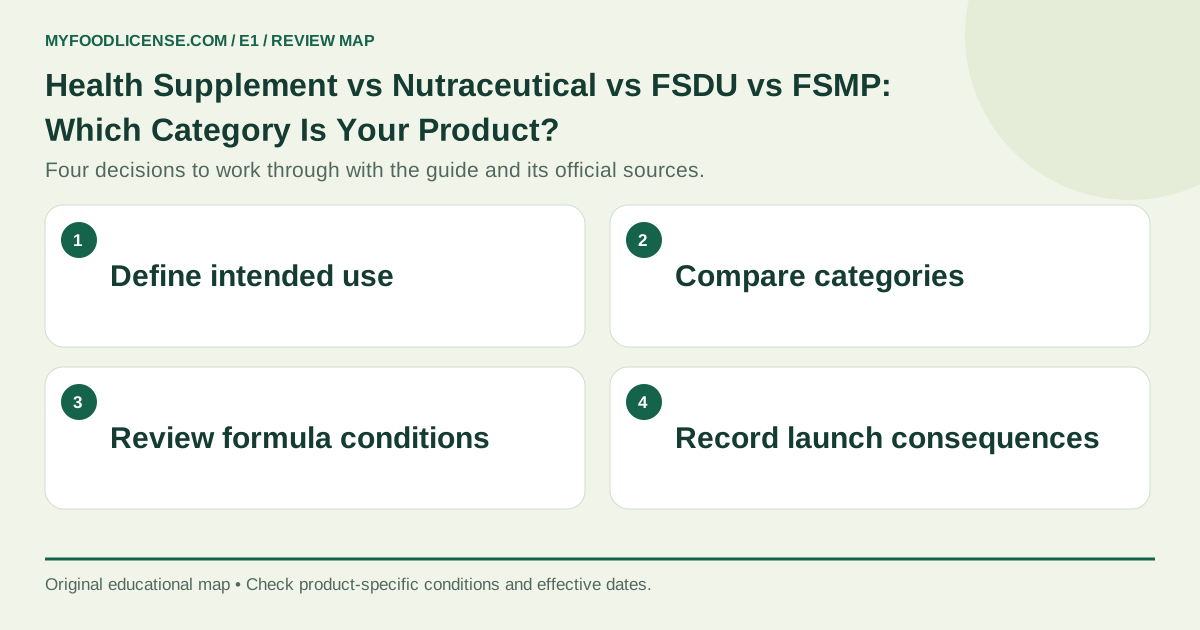
Write the intended use before choosing a name
Record who will consume the product, why, how much and for how long. Specify whether it supplements an ordinary diet, serves a special dietary requirement or manages a medical nutritional need. Review advertising plans as well as the formula.
Compare the relevant definitions
The operationalised 2022 provisions distinguish the categories and their conditions. A general nutrient powder is not automatically FSDU because a sports audience buys it, and FSMP is not a synonym for clinically researched supplement. Read the full definitions and category requirements. Read the category framework.
Check normal-food and drug boundaries
Foods in their normal or naturally occurring forms do not become supplements merely by adding a health-oriented brand. Products defined as drugs are outside the food categories. Claims suggesting treatment, cure or prevention can create a different and problematic representation. Read the FSSAI/AYUSH boundary.
Review formula, dose and format
Ingredient schedules, nutrient levels, additives, warnings and permissible formats can differ by category. Establish each permission for the selected route. An ingredient permitted for one specialised use should not be assumed eligible for another without checking the conditions.
Record approval and launch consequences
FSMP and other specific prior-approval questions are included in the May 2026 ePAAS order. Keep the category decision with approvals, licences and artwork so the same product is not called nutraceutical on one document and ordinary food on another. Read current approval routes.
A worked example
Hypothetical example
A powder marketed for dietary management of a particular medical condition initially uses a generic nutraceutical label. The team reviews intended use, medical-supervision context and the specialised route before assessing ingredients and warnings. The category follows the product’s purpose, not the easiest template.
Your practical checklist
- Document intended use, audience and dosage.
- Compare full category definitions.
- Check normal-food and drug boundaries.
- Review category-specific ingredients and levels.
- Identify approval and label consequences.
- Use one consistent classification record.
Download this preparation checklist
For help applying this review to your business, explore our Nutraceutical / Health Supplement Classification service. Bring the documents described above so the consultation can focus on the decisions still unresolved.
Frequently asked questions
Is every protein powder a supplement?
No. Assess its composition, purpose and presentation.
Is FSMP a marketing upgrade?
No. It has a distinct specialised dietary-management context.
Can ordinary food be renamed a nutraceutical?
The category must fit the regulatory definition and conditions.
Does format determine the route?
No. It is one factor in the complete assessment.
Do category decisions affect warnings?
Yes. Category-specific labelling and usage requirements can differ.
Official sources and further reading
Checked on 2 October 2026. Gazette notifications and operative directions prevail over compilations and summaries, including this guide.
- Operationalised supplement provisions, 29 March 2022 direction: Definitions, schedules, dosage, category-specific warnings and product requirements; read with later directions.
- Direction dated 18 October 2022, uploaded 28 November 2022: Operationalisation of 2022 provisions and May 2022 additions; distinguish directions from final Gazette regulations.
- FSSAI order of 6 May 2026: ePAAS single-window approvals: Exclusive ePAAS submission from 1 June 2026 for specified approval and notification routes.
This guide is general information, not legal advice; the right route depends on your product and business facts. Examples marked hypothetical are illustrations, not client cases. MyFoodLicense is an independent consultancy and is not affiliated with FSSAI; applications are decided by the competent authority on the official FoSCoS portal.