Supplements & nutraceuticals
FSSAI or AYUSH? Herbal and Ayurvedic Products Explained
Herbal origin does not decide whether a product belongs under FSSAI or the Ayurvedic-drug framework. Assess composition, authoritative basis, intended use and claims. Ayurveda Aahara is a specialised food route distinct from Ayurvedic medicines and from an unrestricted herbal supplement category.
By the MyFoodLicense team Sources checked 2 min read
In this guide
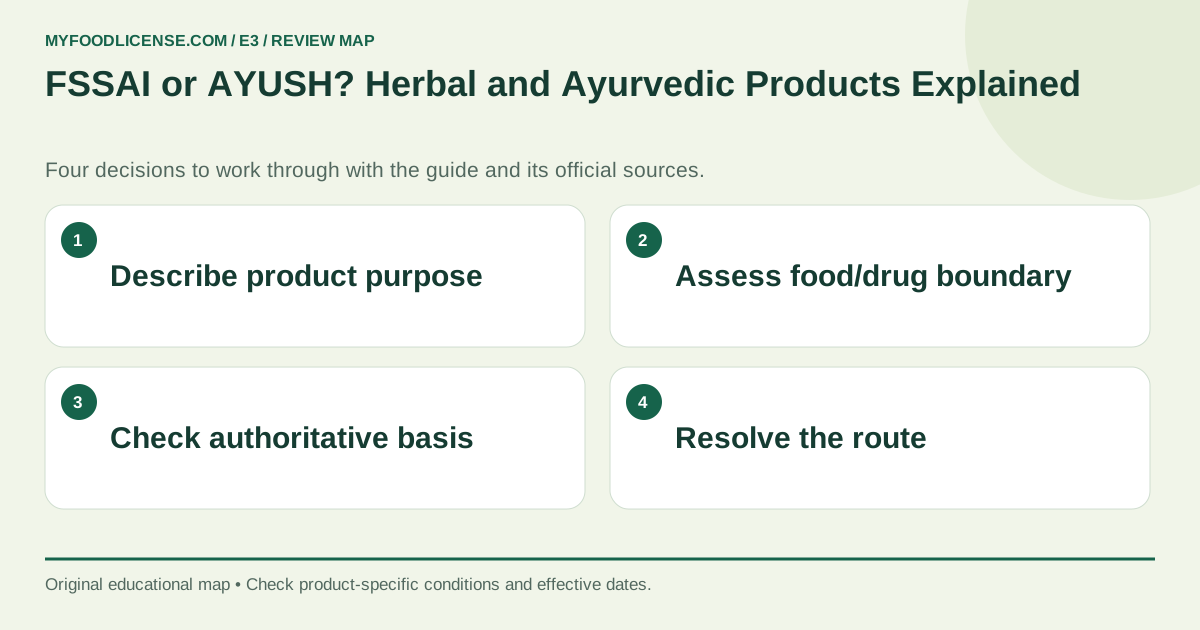
Describe the complete product
Collect the formula, sources, process, intended users, dosage and all proposed claims. A tea, concentrated capsule and product represented as treating a disease can have different questions even when they use the same familiar plant name.
Review the food/drug boundary
The operationalised supplement framework excludes products defined as drugs and addresses disease-related representations. Do not choose a food route merely because it appears easier. Where the product may be a medicine, obtain an appropriate classification assessment under the relevant drug framework. Read scope and exclusions.
Understand Ayurveda Aahara
FSSAI’s Ayurveda Aahara resources include the 2022 regulations and a July 2025 authoritative-text order. Assess the recipe, ingredients and process against that framework rather than using Ayurvedic as a decorative adjective. The route excludes relevant medicinal products and has its own presentation requirements. Official specialised-food resources.
Check botanicals and claims separately
A plant used traditionally as food does not automatically authorise every extract or dose in a supplement. Review the applicable schedules, forms and restrictions. Therapeutic language remains a separate issue even where the ingredient is permitted. Read botanical assessment.
Resolve licence and approval implications
The 2026 table includes a Central manufacturing row for Ayurveda Aahara, and the ePAAS order includes specified approvals for that route. Keep the classification record with its legal basis before requesting a licence or designing the label. Licensing eligibility; approval routing.
A worked example
Hypothetical example
A botanical beverage uses a traditional recipe but advertises relief from a named disease. The review examines both the food-category basis and the proposed therapeutic representation. Traditional origin does not make the claim automatically suitable for a food label.
Your practical checklist
- Record formula, process, users and claims.
- Assess food and drug definitions.
- Check the authoritative Ayurveda Aahara basis.
- Review each botanical form and dose.
- Identify approval and licensing requirements.
- Use category-appropriate label and claim wording.
Download this preparation checklist
For help applying this review to your business, explore our Product Classification service. Bring the documents described above so the consultation can focus on the decisions still unresolved.
Frequently asked questions
Does herbal automatically mean AYUSH?
No. Assess the complete product and intended representation.
Is Ayurveda Aahara the same as medicine?
No. It is a specialised food framework.
Can an FSSAI food claim to cure disease?
Do not assume so. The food framework restricts such representations.
Is every plant extract permitted?
No. Identity, form, dose and route need review.
Does traditional use remove approval questions?
Not automatically. Check the applicable conditions and current route.
Official sources and further reading
Checked on 2 October 2026. Gazette notifications and operative directions prevail over compilations and summaries, including this guide.
- Operationalised supplement provisions, 29 March 2022 direction: Definitions, schedules, dosage, category-specific warnings and product requirements; read with later directions.
- FSSAI Ayurveda Aahara resources: 2022 specialised food framework and July 2025 authoritative-text order; route distinct from Ayurvedic drugs.
- FoSCoS revised Kind-of-Business eligibility table, 2 April 2026 file: Activity-specific eligibility and annual fees. The PDF itself is marked updated 1 April 2026; relevant rows appear on pages 3, 6, 7 and 9.
- FSSAI order of 6 May 2026: ePAAS single-window approvals: Exclusive ePAAS submission from 1 June 2026 for specified approval and notification routes.
This guide is general information, not legal advice; the right route depends on your product and business facts. Examples marked hypothetical are illustrations, not client cases. MyFoodLicense is an independent consultancy and is not affiliated with FSSAI; applications are decided by the competent authority on the official FoSCoS portal.