Registration & licensing
Kind of Business (KOB) on FoSCoS Explained and How to Pick the Right One
Kind of Business, or KoB, describes what your food business does. It affects eligibility, documents and licence scope on FoSCoS. Choose it from actual operations: a food-category number identifies a product category and cannot replace an activity assessment.
By the MyFoodLicense team Sources checked 3 min read
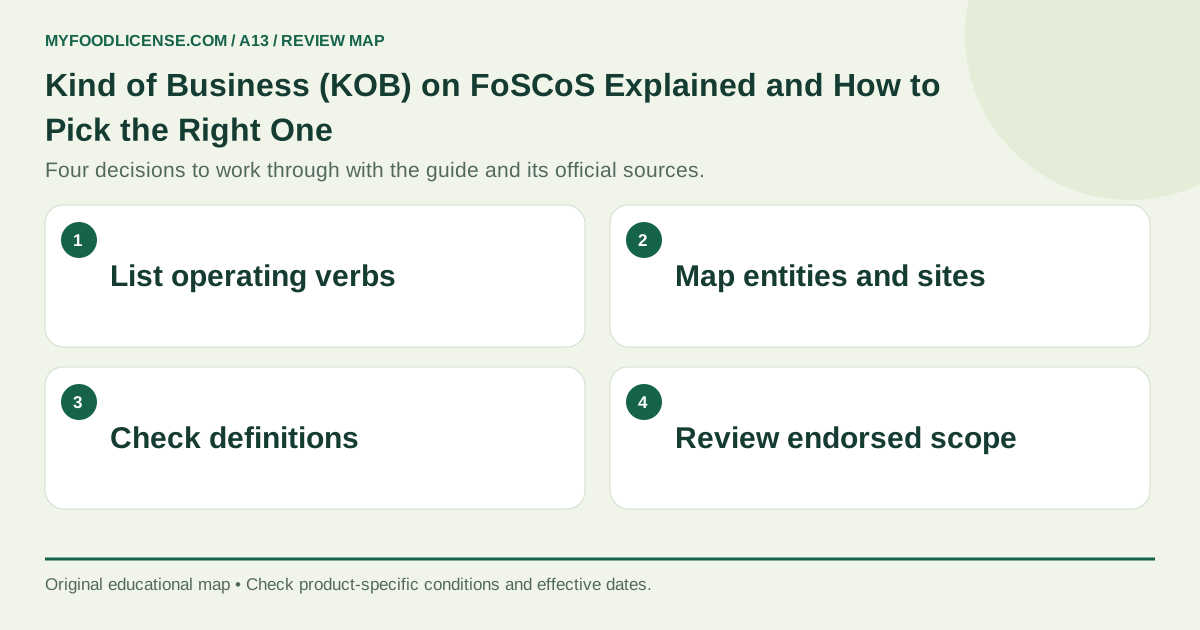
In this guide
Start with verbs rather than brand descriptions
Write whether the business manufactures, repacks, commissions production, imports, stores, transports, distributes, retails or serves food. Terms such as startup, D2C and organic brand describe positioning or channels; they do not explain every activity requiring assessment.
Map responsibility at each premises
Identify who controls processing, stock, invoices and customer delivery. A brand owner outsourcing production can have a different role from the factory. A warehouse operated by a separate entity cannot simply be treated as an invisible extension of the sales office. Document the actual contractual and operational arrangement.
Use the current definitions and criteria
FoSCoS and the revised KoB table provide activity descriptions and route criteria. Check every relevant row, including specialised manufacturing, import, e-commerce and head-office requirements. A low general turnover band does not override a Central-only KoB. Review the definitions and eligibility.
Keep KoB and product classification separate
KoB explains the business role. Product classification establishes the applicable food rules. Food-category codes help locate standards and additive permissions. Keep three distinct columns in your assessment so a correct product-category selection is not mistaken for permission to import, manufacture or relabel. Read the food-category guide.
Review the selection when the business changes
A new production contract, warehouse, import line or retail activity should trigger a scope review. Multiple activities at one premises may need to be included appropriately; multiple premises raise separate questions. Compare what the business actually does with what the certificate endorses, and resolve gaps before filing a modification.
A worked example
Hypothetical example
A beverage brand calls itself an online retailer, but it commissions manufacture, imports one ingredient and operates a storage unit. Mapping the verbs reveals questions that the brand description concealed. The owner can then distinguish the manufacturing partner’s role, its own activities and the storage premises.
Your practical checklist
- List the actual operating verbs.
- Assign each activity to an entity and premises.
- Check the current KoB definitions.
- Review special eligibility rows.
- Separate KoB from product category.
- Compare operations with the certificate scope.
Download this preparation checklist
For help applying this review to your business, explore our Multiple KOB Assessment service. Bring the documents described above so the consultation can focus on the decisions still unresolved.
Frequently asked questions
What does KoB mean?
Kind of Business: the activity or role of the food business in the supply chain.
Is a category code the same as KoB?
No. One describes the food category, the other the business activity.
Can I choose the cheapest KoB?
The selection must match actual operations and current eligibility.
Can a brand owner be a relabeller?
Its manufacturing arrangement may lead to that assessment; examine the actual role rather than the brand name.
Can KoB change later?
Yes. Added or changed activities require a review of the relevant modification or new-application route.
Official sources and further reading
Checked on 2 October 2026. Gazette notifications and operative directions prevail over compilations and summaries, including this guide.
- FoSCoS revised Kind-of-Business eligibility table, 2 April 2026 file: Activity-specific eligibility and annual fees. The PDF itself is marked updated 1 April 2026; relevant rows appear on pages 3, 6, 7 and 9.
- Official FoSCoS application portal: Official applications, help topics, current document lists and eligibility information.
- FSSAI licensing and registration FAQs, 26 July 2022: Online document submission and general application concepts only. Old turnover, validity, renewal and fee guidance is superseded by 2026 sources.
This guide is general information, not legal advice; the right route depends on your product and business facts. Examples marked hypothetical are illustrations, not client cases. MyFoodLicense is an independent consultancy and is not affiliated with FSSAI; applications are decided by the competent authority on the official FoSCoS portal.