Labelling & packaging
Mandatory Label Declarations for Packaged Food in India (Checklist)
A packaged-food label in India needs a coordinated set of food, business, traceability and commercial declarations. The exact checklist depends on the category and pack. Review FSSAI requirements alongside Legal Metrology and specialised rules before approving artwork.
By the MyFoodLicense team Sources checked 3 min read
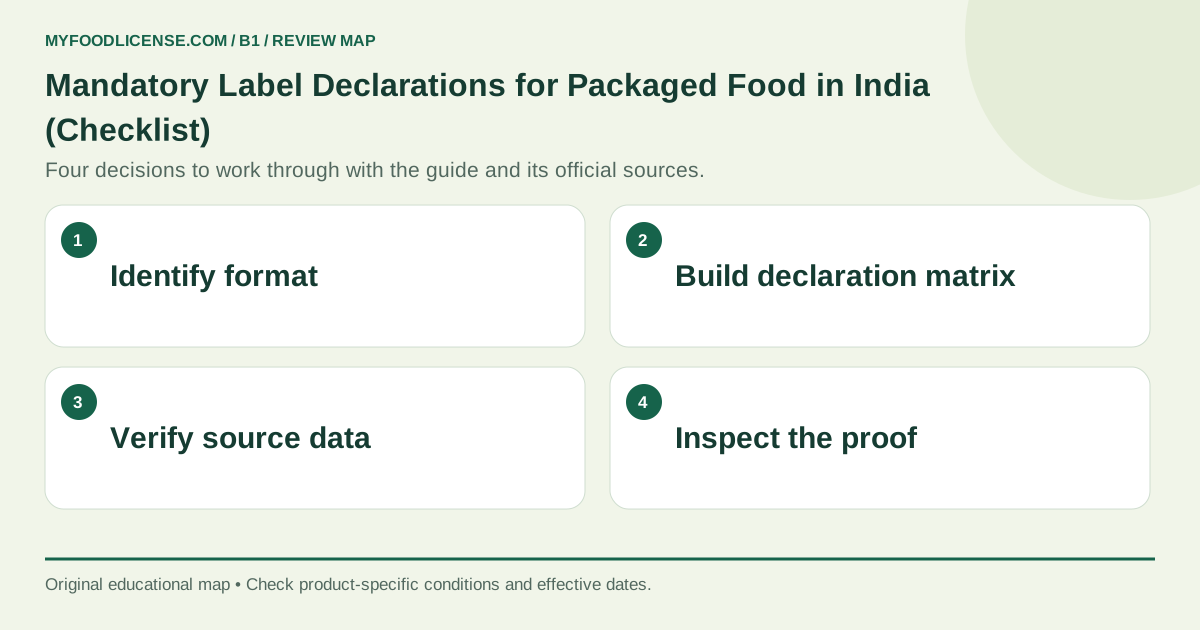
In this guide
Start with the product and sale format
Identify the legal food name, recipe, category, retail or non-retail format, local manufacture or import, and any specialised regime. A generic checklist for a retail snack cannot establish the complete requirements for infant food, supplements or a bulk transport container.
Build the declaration matrix
| Review area | Typical information to assess |
|---|---|
| Food identity | Name, ingredients, additive declarations and allergen information |
| Nutrition and presentation | Required nutrition information, serving basis, applicable symbols and claims |
| Responsible businesses | Relevant names, addresses, FSSAI logo and licence numbers |
| Traceability and use | Batch or lot, manufacture/packing, expiry/use-by, storage and instructions |
| Commercial details | Net quantity, MRP including taxes, consumer-care details and applicable unit sale price |
Use the actual provisions and exceptions when converting this matrix into copy. Labelling and Display Regulations; Legal Metrology overview.
Check where and how information appears
Mandatory content must be legible and meet relevant placement, language and size requirements. A complete spreadsheet does not establish that a crowded label works at actual print size. Review the principal display panel, contrast, folds and seams, and variable coding areas.
Keep imported and specialised requirements separate
Imported products need the applicable importer and country-of-origin assessment. Supplement and other specialised labels can require additional warnings or category statements. Do not delete these because a competitor’s pack appears simpler. Read supplement declarations.
Control versions before print
Assign a source and owner to every declaration. Check the final recipe against ingredient and allergen copy, the report against nutrition values, and the issued certificate against business details. The March 2026 amendment has provisions effective in July 2027; record timing before changing current copy. Read the dated amendment.
A worked example
Hypothetical example
A snack pouch contains all headings but uses the factory address from an old production agreement. The review checks the manufacturing site and responsible businesses against the current certificate, then rechecks the finished proof. Completeness and factual accuracy are separate review tasks.
Your practical checklist
- Confirm category and retail format.
- Prepare food and nutrition declarations.
- Verify responsible-business details.
- Plan batch, date and storage information.
- Review Legal Metrology requirements.
- Approve legibility at actual pack size.
Download this preparation checklist
For help applying this review to your business, explore our Basic Artwork Review service. Bring the documents described above so the consultation can focus on the decisions still unresolved.
Frequently asked questions
Does every food use the same label checklist?
No. Category, format, import status and specialised rules change the assessment.
Is MRP an FSSAI-only requirement?
Assess it under Legal Metrology alongside food-labelling rules.
Is best-before alone sufficient?
Review the current date-marking provision and applicable exemptions; do not assume so.
Can mandatory copy appear in any language?
Apply the prescribed language rules and any category-specific requirements.
Can a draft amendment be used immediately?
Check legal status and effective date before treating a proposal as an operative requirement.
Official sources and further reading
Checked on 2 October 2026. Gazette notifications and operative directions prevail over compilations and summaries, including this guide.
- Labelling and Display Regulations compendium, Version VIII, 9 September 2025: Regulation 5: retail declarations, nutrition, dates and allergens. Read alongside later amendments and directions.
- Department of Consumer Affairs: packaged-commodity declarations: Net quantity, MRP including taxes, consumer care and unit sale price overview.
- Labelling and Display First Amendment Regulations, 24 March 2026: Effective 1 July 2027; infant-nutrition RDA declarations, nutrition exemptions and non-retail containers. Do not describe as already effective in October 2026.
This guide is general information, not legal advice; the right route depends on your product and business facts. Examples marked hypothetical are illustrations, not client cases. MyFoodLicense is an independent consultancy and is not affiliated with FSSAI; applications are decided by the competent authority on the official FoSCoS portal.