Labelling & packaging
FSSAI Labelling Requirements: A Complete Guide for Packaged Food Brands
A compliant food label starts with the correct product identity, accurate formulation information and the declarations applicable to that product and pack. Review FSSAI labelling rules together with relevant Legal Metrology requirements before approving the artwork for print.
By the MyFoodLicense team Sources checked 8 min read
In this guide
- Which labelling rules should a food brand check?
- Mandatory declarations: a retail-pack checklist
- Use the product's true identity as the starting point
- Build ingredients, allergens and nutrition from reliable inputs
- Review dates, coding and storage as an operating system
- Check the entities, licence details and commercial declarations
- Understand the 2026 amendment and its future effective date
- Review promotional claims across the whole pack
- A practical artwork sign-off process
- Explore the detailed guides
- Frequently asked questions
- Official sources
Which labelling rules should a food brand check?
The Labelling and Display Regulations, 2020 address packaged-food labels and certain display information. Read the current compilation alongside later amendments and directions, plus any specialised product rules. FSSAI labelling compendium.
The Department of Consumer Affairs separately explains packaged-commodity declarations, including net quantity, retail price and consumer-care information. A food label therefore needs review across both areas. Official Legal Metrology overview.
Begin the review by recording the exact product and pack. A retail pouch, a non-retail container and a specialised nutrition product may raise different questions. Do not take a checklist prepared for one product and silently apply it to another.
Create a source list with a review date. Note the relevant regulation, amendments, product standard and any operative direction. Where a requirement changes, record when it becomes applicable to your planned artwork. This prevents a draft proposal or a future amendment from being mistaken for today's rule.
Mandatory declarations: a retail-pack checklist
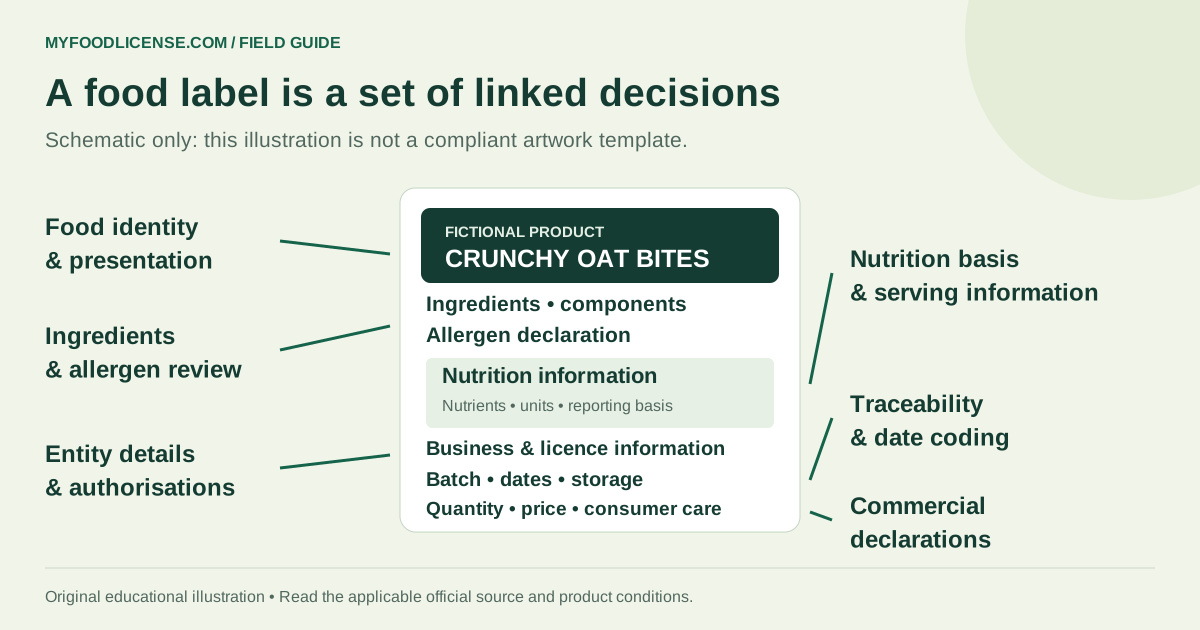
For an ordinary pre-packaged retail food, assess the applicable declarations below and any exemptions or additional category rules. This is a review map, not a claim that every row appears identically on every pack. See regulation 5 and related provisions.
| Declaration area | Review question |
|---|---|
| Food name | Does the name identify what the product actually is? |
| Ingredients and additives | Does the declaration reflect the formulation and relevant component information? |
| Allergens | Have the relevant ingredients and cross-contact questions been assessed? |
| Nutrition information | Are the applicable nutrients, units, bases and serving details consistent? |
| Vegetarian/non-vegetarian declaration | Is the applicable symbol used with the required presentation? |
| Business details and licence information | Are the responsible entities and applicable FSSAI details correctly identified? |
| Batch and dates | Can the printed pack be traced to the product's actual coding records? |
| Storage, use and special declarations | Does the product need instructions or category-specific statements? |
| Quantity, price and consumer care | Have applicable Legal Metrology declarations been reviewed? |
| Imported-food information | Have origin, importer and applicable import requirements been checked? |
For each row, record “included,” “conditional,” “exemption assessed” or “action required.” Retain the reasoning behind an exemption. A blank space on artwork should not be the only evidence that someone considered the requirement.
Download the pre-print review worksheet
Use the product's true identity as the starting point
FSSAI's labelling FAQ explains that the food's prescribed, common or descriptive name must convey its nature. A brand or fanciful name may accompany it within the applicable conditions. Official FAQ on the name of food.
Give the designer a regulatory naming brief before artwork begins. Include the proposed descriptive name, the product classification and the assumptions underlying both. If the formulation changes during development, review the naming brief again.
Hypothetical example
A brand develops “Morning Crunch,” a name that could describe several different foods. The naming review asks the team to identify the actual product beneath the brand name. A clear descriptive name makes the pack easier to assess and helps the designer allocate space before decorative copy is finalised.
Review pictures alongside words. An image of a particular fruit or grain can influence the consumer's understanding of the composition. Ask the team what evidence supports the visual emphasis and whether any associated declaration question needs examination.
Build ingredients, allergens and nutrition from reliable inputs
Prepare one controlled formulation record for each SKU. Include the components of compound ingredients, supplier specifications and the assumptions used to develop the label. Ask suppliers for clarification where a proprietary blend name conceals information the reviewer needs.
Ingredient order follows the formulation at manufacture. Relevant allergenic ingredients require the applicable separate declaration; the rules include exemptions and conditions that need product-level review. Review the ingredient and allergen provisions.
A useful ingredient review tracks the item used, its supplier name, its descriptive identity, its components and any unresolved declaration issue. This lets the reviewer reconcile the recipe with the label without guessing what a trade name means.
For nutrition, record the evidence source, the product tested or calculated, the reporting units and the basis of the label values. Check whether the report relates to the finished formulation and serving assumptions. Avoid transferring a table from a supplier's raw material onto a finished food pack.
Run an independent arithmetic check before print approval. Look for accidental swaps between milligrams and grams, values reported per serving but headed per 100 g, and changes to serving size that were not reflected elsewhere. Those checks are practical quality controls, rather than a prescribed testing method for every product.
Review dates, coding and storage as an operating system
The current labelling text provides for manufacture or packing and expiry/use-by declarations, with best-before information optional or additional, subject to applicable exceptions. Review the product's date-marking rule. Read regulation 5(10).
Separate the fixed artwork from the information printed during production. Ask where the batch and dates will appear, how the printer applies them and whether the location remains readable after packing. A compliant design concept still needs a workable production method.
Confirm the storage statements with the team responsible for the product's shelf-life assessment. The artwork reviewer needs to understand the assumptions behind the chosen wording. If the product is sensitive after opening, review that use scenario as part of the brief.
Hypothetical example
A refrigerated product has attractive artwork but no reserved coding area. The pre-print review asks the production team to demonstrate where the code will be placed and how it will be read on the finished pack. This catches a production-design gap before the full packaging order.
Check the entities, licence details and commercial declarations
Make a responsibility map for the brand owner, manufacturer, packer, marketer and importer where relevant. Compare it with the business arrangements and current authorisations. The label should be reviewed against that map, rather than copied from a competitor's pack.
Ask the commercial team to provide the intended pack quantity and pricing information. Confirm how consumer enquiries will be received and handled. Put these inputs through the relevant Legal Metrology review instead of treating them as decorative text added at the end.
A change of manufacturer, packer or importer should trigger a label review. Keep those business changes in the same change-control process as ingredient substitutions and pack-size changes. That helps prevent artwork from becoming detached from the actual supply chain.
Understand the 2026 amendment and its future effective date
The amendment notified on 24 March 2026 is stated to come into force on 1 July 2027. It addresses areas including infant-nutrition RDA information, certain nutrition exemptions and non-retail container declarations. Do not label those future provisions as already mandatory in October 2026. Read the 2026 Gazette amendment.
For a packaging project, put the anticipated manufacture and artwork-use periods into the brief. Ask whether the packaging order may extend across an effective-date boundary. The answer can affect the change plan even when the current artwork is being reviewed today.
Use a simple change register: source, publication date, effective date, affected SKU, action and owner. Check later directions before a production decision. The official regulations directory is the place to begin that source review.
Review promotional claims across the whole pack
A declaration checklist does not settle claims such as “natural,” “high protein” or a health benefit. Give promotional wording its own review against the formula and evidence. The food-claims guide explains the questions to ask.
FSSAI's May 2025 advisory asks food businesses to discontinue “100%” claims on labels and promotional material because of misleading implications. Identify this as an advisory and assess the actual wording in context. Read the direct advisory.
Keep an inventory of claims on the front, back, side panels, website images and product descriptions. If the pack changes, update the sales material too. A print correction alone may leave the old statement visible to customers elsewhere.
A practical artwork sign-off process
- Freeze the review inputs. Identify the formulation, specifications, product classification and artwork version.
- Run the declaration review. Use the applicable rules and record conditional requirements or exemptions.
- Review claims and visuals. Assess the consumer message alongside supporting evidence.
- Review the actual dieline. Check legibility, folds, seals and coding space on the final layout.
- Reconcile the final proof. Compare the printer's proof with the corrected version before approving production.
- Archive the decision. Retain the reviewed file, corrections and named sign-off.
myfoodlicense.com offers comprehensive artwork review and packaging compliance review. Supply the entire pack and the underlying product information so the review can address the facts that matter.
Explore the detailed guides
Use these focused articles to work through the decisions relevant to your business.
- Mandatory Label Declarations for Packaged Food in India (Checklist)
- 12 Label Mistakes That Get Food Products Into Trouble
- How to Write a Statement of Ingredients the FSSAI Way (Order, Percentages, Compound Ingredients)
- Declaring Food Additives on a Label: Class Titles and INS Numbers
- Allergen Labelling in India: What to Declare and How
- How to Make a Nutrition Information Table for Your Label
- Veg and Non-Veg Logo Rules (Size, Colour, Placement)
- FSSAI Logo and Licence Number on the Label: Rules
- Legal Metrology on Food Packs: Net Quantity, MRP and Consumer Care
- Date Marking: Best Before vs Use By vs Expiry
- Front-of-Pack Labelling in India: Where Things Stand
- Label Rules for Small Packs and Multipacks
- Pre-Print Checklist: What to Check Before Your Label Goes to the Printer
- Harmonising Labels Across a Product Range
Frequently asked questions
Can I use another brand's label as my compliance template?
Use it only as a design reference. Your product, formulation, entities, claims and pack need their own review against the applicable requirements.
Is best before always enough for an Indian food label?
Review the current date-marking provision and the product-specific exceptions. Do not assume a best-before statement substitutes for every required date declaration.
Are the March 2026 labelling changes already effective?
The cited amendment specifies 1 July 2027. Check any later directions before a production decision and plan packaging transitions by effective date.
Is the illustrated pack in this guide ready to print?
No. It is an educational map of review areas and deliberately omits a complete formulation, official symbols, licence details and dimensional requirements.
What should I send for a label review?
Send complete artwork, the final formulation, relevant specifications, nutrition evidence, entity and licence details, pack dimensions and the claims you want to make.
Official sources and further reading
Checked on 2 October 2026. Gazette notifications and operative directions prevail over compilations and summaries, including this guide.
- Labelling and Display Regulations compendium, Version VIII, 9 September 2025: Regulation 5: retail declarations, nutrition, dates and allergens. Read alongside later amendments and directions.
- FSSAI Labelling and Display FAQs, 23 June 2022: Naming food and practical interpretation of labelling requirements, subject to later amendments.
- Labelling and Display First Amendment Regulations, 24 March 2026: Effective 1 July 2027; infant-nutrition RDA declarations, nutrition exemptions and non-retail containers. Do not describe as already effective in October 2026.
- Department of Consumer Affairs: Legal Metrology overview: Packaged commodity declarations including quantity, price and consumer-care details; review the applicable rules and exemptions.
- FSSAI advisory dated 28 May 2025: discontinuation of 100% claims: Direct official advisory on 100% label and promotional claims; identify it as an advisory.
- FSSAI current regulations directory: Product standards, specialised regulations, original notifications, compendiums and amendment lists.
This guide is general information, not legal advice; the right route depends on your product and business facts. Examples marked hypothetical are illustrations, not client cases. MyFoodLicense is an independent consultancy and is not affiliated with FSSAI; applications are decided by the competent authority on the official FoSCoS portal.