Claims & advertising
Misleading Food Ads: Penalties and Real Examples
Misleading food advertising can create liability under section 53 of the Food Safety and Standards Act and other applicable frameworks. The section states a penalty up to ₹10 lakh for its defined conduct. Actual liability depends on the advertisement, evidence and legal process.
By the MyFoodLicense team Sources checked 3 min read
In this guide
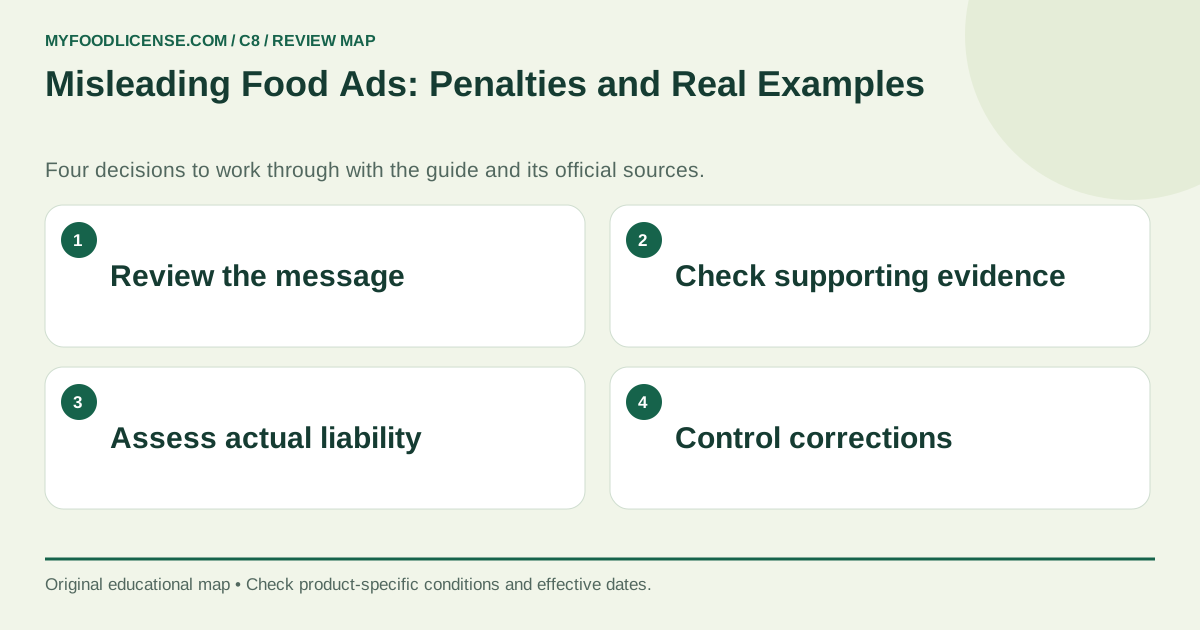
Review express and implied messages
The Act addresses advertising that misleads or deceives about food and false guarantees, with its stated scope. Product names, pictures and testimonials can matter alongside the sentence in small print. A disclaimer cannot be assumed to neutralise a contradictory dominant message. Read section 53.
A documented example: 100% representations
FSSAI’s 28 May 2025 advisory asks food businesses to discontinue use of 100% on labels and promotional material. The authority explains the misleading potential and absence of a defined regulatory basis. This is a real official advisory, not a claim that a particular company was convicted or fined. Read the advisory.
A regulatory example: natural brand wording
The claims regulations specify a disclaimer where listed adjectives in a brand, trademark or fancy name are likely to mislead about the food’s nature. This is a concrete regulatory response to a type of misleading representation. It does not establish that every brand containing such a word has committed an offence. Read the brand-name provision.
Distinguish statutory maxima from case outcomes
Do not present the section 53 maximum as the fine imposed in every case. Misbranding and unsafe-food provisions are separate. Where an actual notice arrives, identify the grounds, channels, versions and period concerned, preserve evidence and obtain advice on the response. Read notice handling.
Build a prevention and correction system
Approve exact wording against the product file, control campaign variants and monitor published material. Where an error is identified, assess removal, correction and affected stock or channels promptly. Keep a record of the assessment and action; a private instruction to an agency is not proof that every advertisement has changed.
A worked example
Hypothetical example
A brand’s compliant no-added-sugar pack is advertised online as completely sugar-free. The campaign review identifies a distinct concentration claim lacking support. It corrects the channel wording and preserves the evidence record instead of relying on the pack’s different statement.
Your practical checklist
- Archive the exact advertisement and channel.
- Review express and implied claims.
- Match wording to evidence and criteria.
- Distinguish advisory, allegation and adjudicated outcome.
- Assess actual notices and deadlines separately.
- Document corrections across all affected channels.
Download this preparation checklist
For help applying this review to your business, explore our Advertisement Review service. Bring the documents described above so the consultation can focus on the decisions still unresolved.
Frequently asked questions
Is ₹10 lakh an automatic fine?
No. It is the maximum in the cited section for its defined conduct.
Are the examples convictions?
No. They are an official advisory and a regulatory provision, identified accurately.
Can a small disclaimer fix any ad?
No. Assess the complete consumer impression.
Do online ads count?
The applicable food-claim framework should be assessed across advertising channels.
What should I preserve after a notice?
The notice, receipt date, exact campaign versions, product evidence and response records.
Official sources and further reading
Checked on 2 October 2026. Gazette notifications and operative directions prevail over compilations and summaries, including this guide.
- Food Safety and Standards Act, 2006: Sections 23–32, 46 and 48–67; numerical penalties are maxima and require case-specific interpretation.
- 2026 Jan Vishwas amendment document hosted by FSSAI: Read Food Safety Act entry and verify commencement; does not replace sections 53 or 63.
- Advertising and Claims Regulations compendium, Version IV, 14 December 2022: Nutrition-claim thresholds and general claim conditions. Protein uses RDA-based alternatives, not a universal percentage-of-energy rule.
- FSSAI advisory dated 28 May 2025: discontinuation of 100% claims: Direct official advisory on 100% label and promotional claims; identify it as an advisory.
This guide is general information, not legal advice; the right route depends on your product and business facts. Examples marked hypothetical are illustrations, not client cases. MyFoodLicense is an independent consultancy and is not affiliated with FSSAI; applications are decided by the competent authority on the official FoSCoS portal.