Claims & advertising
Food Claims in India: What You Can Say on Packs, Websites and Ads
A food claim must fit the product, the applicable conditions and the evidence behind it. Review the same message wherever customers see it: on the pack, the website, marketplace listings, advertising and promotional content.
By the MyFoodLicense team Sources checked 8 min read
In this guide
- What counts as a food claim?
- Separate nutrition, non-addition and health claims
- Common nutrition-claim criteria to verify
- No added sugar is a formulation question
- Health claims need evidence matched to the actual assertion
- Natural, fresh, pure and absolute claims
- Comparisons need a defensible reference
- Build a claims file before approving artwork
- Keep websites, listings and campaigns consistent
- Explore the detailed guides
- Frequently asked questions
- Official sources
What counts as a food claim?
The Advertising and Claims Regulations address consumer messages beyond the package. Claims can concern composition, nutritional properties, origin, processing or health; advertisements and marketing communications have a broad scope. Read the original regulations alongside amendments.
Begin with an inventory of what a customer would see or hear. Include words, pictures, comparisons, captions and spoken scripts. A small line beneath a large headline may affect the overall message, but it cannot be assumed to repair it.
Review the product title and brand presentation too. The useful question is what the entire communication tells a consumer about this food. Treat the answer as a hypothesis to assess against the product's facts, rather than focusing on one carefully chosen word.
Separate nutrition, non-addition and health claims
| Proposed message | Primary review question |
|---|---|
| “High protein” or “low fat” | Does the product meet the applicable nutrient-content condition? |
| “No added sugar” | Does the formulation and manufacturing process support non-addition? |
| A statement about a physiological benefit | What claim type, evidence and conditions apply? |
| “Less sugar than…” | Is the comparison valid, identifiable and properly presented? |
| “Natural” or “fresh” | Do the conditions for the term fit the product and processing? |
The categories are useful because each asks a different evidentiary question. A nutrient test, a recipe record and a scientific dossier perform different jobs. Decide what the claim asserts before choosing the evidence that might support it.
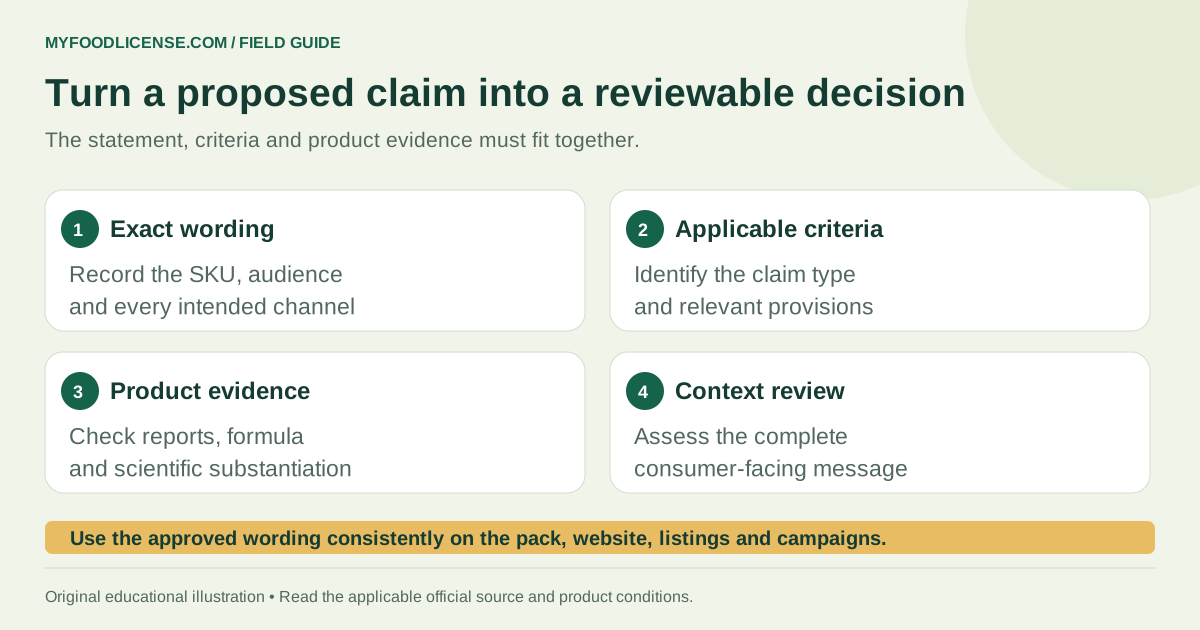
Give each proposed statement a unique entry in a claims register. Record the exact words, SKU, channel, intended audience and reviewer. Avoid approving a vague concept such as “health messaging” when the actual advertisement has not been written.
Common nutrition-claim criteria to verify
The current claims compendium provides the following selected conditions. They are screening references; assess the complete rule and product context before using a claim. Schedule I and general conditions.
| Claim | Selected condition |
|---|---|
| Sugar free | Sugars no more than 0.5 g per 100 g or 100 ml. |
| Low fat | Fat no more than 3 g/100 g for solids or 1.5 g/100 ml for liquids. |
| High/rich in protein | Protein at least 20% of RDA/100 g for solids; 10%/100 ml for liquids; or the specified alternatives of 10%/100 kcal or 20%/serving. |
Protein needs an RDA-based assessment under the Indian conditions. Do not substitute a foreign percentage-of-energy criterion. Read the protein row in full.
Hypothetical calculation check
A beverage report shows 0.8 g sugars per 100 ml, while the copywriter uses “sugar free.” Comparing the value with the selected condition exposes a mismatch. Before changing the wording, verify that the report, units and formulation match the product being marketed.
Include a reasonable review margin in the development discussion. If the product is close to a claim boundary, ask the technical team how changes in formulation, ingredients and production could affect the result. The claim-review decision should reflect the evidence for the product that will actually be sold.
No added sugar is a formulation question
The non-addition conditions look beyond table sugar: sugars can come from components and ingredients used to replace added sugar. Naturally present sugars require the applicable accompanying statement when the claim is used. Review regulation 6.
Make a component-level ingredient map. For each supplier ingredient, identify what it contains and why it is used. Ask whether a sweetened component, syrup, fruit preparation or processing step changes the claim assessment. Resolve uncertain supplier descriptions before making a blanket statement.
Hypothetical formulation review
A recipe uses unsweetened oats and a fruit preparation whose component list has not been collected. The team should obtain that list and understand the ingredient's function before settling the claim. A purchase invoice saying “fruit mix” cannot establish the complete formulation.
Keep the assessment with the approved recipe version. If procurement later changes the ingredient, ask whether the approved non-addition wording remains supported. Supplier changes should reach the label and marketing reviewers before the product goes back into production.
Health claims need evidence matched to the actual assertion
The regulations distinguish health claims from nutrient-content statements and prohibit medicinal claims except where specifically permitted. Product-health claims have particular evidence requirements; a general paper about an ingredient is not automatically a basis for the finished product's claim. Review health and prohibited-claim provisions.
Write the proposed benefit in a complete sentence. Identify the product or constituent said to produce the benefit, the intended audience and the consumption conditions. Then ask the scientific reviewer whether the evidence addresses that proposition.
A study can be relevant yet leave important gaps. The studied ingredient may have a different specification; the dose may differ; the study population may not match the audience; or the outcome may be narrower than the headline. Document those differences rather than hiding them behind a long bibliography.
For a review dossier, create an evidence table with the study, tested material, use level, population, outcome and limitations. Keep the original paper or source reference. A marketing summary of the research should be checked against what the study actually reports.
When a claim or category requires a particular regulatory route, establish that route before running a campaign. myfoodlicense.com offers complete claims review and substantiation-dossier preparation.
Natural, fresh, pure and absolute claims
The terms “natural,” “fresh” and “pure” have conditional treatment in the claims rules. Check the actual product and processing. A favourable consumer association with a word is not sufficient grounds to use it. Read the conditional terminology provisions.
Describe the process accurately in the technical brief. Include processing stages, preservation and the role of additives. This gives the reviewer useful facts instead of a marketing explanation such as “made with good ingredients.”
FSSAI's advisory dated 28 May 2025 asks businesses to discontinue “100%” on labels and promotional content because it can misleadingly imply absolute purity or superiority. The advisory is a distinct source of current regulatory guidance. Read the official advisory.
Review every place that uses the affected expression. Product images may be stored in a website media library, seller portal and advertising account. Assign an owner to replace each asset and keep the revised versions in one controlled folder.
Comparisons need a defensible reference
Before approving a comparative message, define the reference product and the comparison basis. Keep the original measurements or specifications and the calculation used. A statement chosen first and supported afterwards is more likely to hide an assumption the team has not examined.
Use like-for-like units and understand whether the compared foods and versions fit the applicable rules. Have a reviewer check the chosen wording and reference in the current amended text. Avoid relying on a comparator that no longer exists or on an unexplained industry average.
Hypothetical comparison file
A brand compares two versions of its product but one nutrition table is per serving and the other per 100 g. Its first task is to align the data basis. Only then can the team calculate and review the proposed statement. The illustration does not approve any percentage claim.
Build a claims file before approving artwork
Use one record per claim. Keep the exact wording, approved product version, evidence sources, assessment, conditions of use and review date. Add any requirement to revisit the decision when evidence or the product changes.
- Identify who owns the recipe and product specifications.
- Record the claim type and the applicable source provision.
- Retain relevant reports and any checked calculations.
- Document what the claim assessment assumes and excludes.
- Store the approved wording with the final artwork and digital copy.
- Set a trigger for reassessment after formulation, supplier or audience changes.
Download the claim-review worksheet
Keep websites, listings and campaigns consistent
Make an asset register for the pack, website, marketplaces, advertisements and promotional scripts. Assign the approved wording to each asset. Before launch, check whether anyone has shortened the phrase in a way that changes its meaning.
A claim can drift when a sales team turns a qualified statement into a short headline or a creator improvises a stronger benefit. Give everyone the approved wording and the evidence-based boundaries. Review revised scripts and customer-facing assets before they are used.
Connect this process with the label review and product classification. A claim assessment is strongest when the reviewer knows exactly which food, category and consumer communication are being considered.
Explore the detailed guides
Use these focused articles to work through the decisions relevant to your business.
- Can You Call Your Food "Natural", "Fresh", "Pure" or "Original"?
- "High Protein", "Low Fat", "Sugar Free": Criteria for Nutrition Claims
- Nutrition Claims vs Health Claims: The Difference and Why It Matters
- "No Added Sugar" vs "Sugar Free" vs "Zero Sugar"
- "Immunity Booster" and Other Risky Claims Brands Still Make
- Influencer Marketing for Food Brands: The Rules on Claims
- Comparative Claims ("30% Less Sugar"): How to Make Them Safely
- Misleading Food Ads: Penalties and Real Examples
- Do You Need Evidence for Your Claim? Building a Substantiation File
Frequently asked questions
Can I write sugar free if I have not added table sugar?
Check the final product's sugar level and the applicable sugar-free condition. Absence of table sugar does not establish that nutrient-content claim.
Does a high-protein claim use a percentage-of-energy rule in India?
The cited Indian protein conditions use RDA-based alternatives. Check the complete applicable condition, product data and relevant RDA basis.
Can research about one ingredient justify a product health claim?
The evidence must address the actual claim and product context. Differences in specification, use level, audience and study outcome can matter.
Do the same claim rules apply to website copy?
Review digital marketing as part of the claims assessment. The regulations have a broad scope covering advertisements and marketing communications.
Can I use 100% natural on a food label?
Review the conditional terminology rules and FSSAI's May 2025 advisory asking businesses to discontinue 100% claims on labels and promotional materials.
Official sources and further reading
Checked on 2 October 2026. Gazette notifications and operative directions prevail over compilations and summaries, including this guide.
- Advertising and Claims Regulations compendium, Version IV, 14 December 2022: Nutrition-claim thresholds and general claim conditions. Protein uses RDA-based alternatives, not a universal percentage-of-energy rule.
- Original Advertising and Claims Regulations, 2018: General scope, truthful advertising, prohibited medicinal claims and conditional terminology; read current amended text for numerical claims.
- FSSAI advisory dated 28 May 2025: discontinuation of 100% claims: Direct official advisory on 100% label and promotional claims; identify it as an advisory.
- Labelling and Display Regulations compendium, Version VIII, 9 September 2025: Regulation 5: retail declarations, nutrition, dates and allergens. Read alongside later amendments and directions.
- FSSAI current regulations directory: Product standards, specialised regulations, original notifications, compendiums and amendment lists.
This guide is general information, not legal advice; the right route depends on your product and business facts. Examples marked hypothetical are illustrations, not client cases. MyFoodLicense is an independent consultancy and is not affiliated with FSSAI; applications are decided by the competent authority on the official FoSCoS portal.