Registration & licensing
Penalty for Running a Food Business Without an FSSAI Licence
Operating a food business without the required FSSAI licence can attract prosecution under section 63 of the Food Safety and Standards Act. The applicable provision depends on the business and authorisation requirement; small-business registration issues should not be described with a single universal penalty.
By the MyFoodLicense team Sources checked 3 min read
In this guide
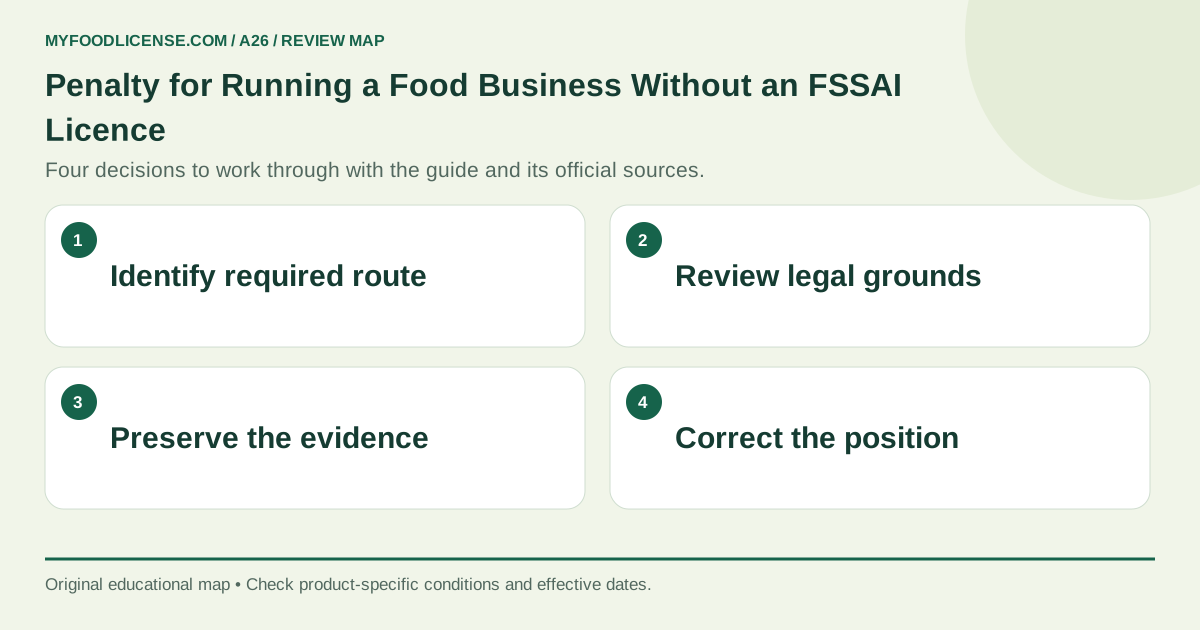
Establish which authorisation is required
Start with the actual activity, premises and current eligibility. Section 31 contains the licensing requirement and treatment of petty food businesses. The revised 2026 bands can change the route, while special KoB rows still apply. Read sections 31 and 63; current eligibility.
Understand the section 63 maximum
The Act’s section 63 concerns a person required to obtain a licence who conducts the stated food activities without one, except the exemption addressed through section 31(2). It provides imprisonment up to six months and a fine up to ₹5 lakh. These are statutory maxima, not an automatic bill for every registration lapse. Read the operative law and facts before applying them.
Other offences are separate
Unsafe food, misbranding, misleading advertising, obstruction and false information have their own provisions. Obtaining an authorisation later does not automatically erase earlier conduct. Conversely, a portal upload problem does not itself establish every element of an offence. Keep legal classification separate from general warnings.
Respond to an actual notice carefully
Preserve the notice, certificate history, application evidence, operating dates and current activity details. Do not backdate records or make unsupported admissions. Obtain professional advice on the allegations, deadline and appropriate response, while addressing immediate food-safety issues. Read the notice-response guide.
Correct the authorisation position
Assess the proper application or restoration route, resolve outstanding obligations and verify active status before undertaking activities requiring authorisation. The current perpetual-validity framework also prohibits operation during suspension. A pending application or payment receipt is not the issued certificate.
A worked example
Hypothetical example
A trader receives a notice alleging operation without a licence. Its file establishes the actual activity, turnover period and historical authorisation record. The response assesses the applicable route and dates rather than accepting a generic online claim that every small food seller automatically faces the same punishment.
Your practical checklist
- Identify the required route and relevant period.
- Read the actual statutory allegation.
- Treat maximum penalties as maxima.
- Preserve applications and certificate history.
- Obtain advice on a real notice.
- Resolve and verify the authorisation position.
Download this preparation checklist
For help applying this review to your business, explore our Basic FSSAI Registration service. Bring the documents described above so the consultation can focus on the decisions still unresolved.
Frequently asked questions
Is the fine always ₹5 lakh?
No. Section 63 states a maximum and has a defined licensing scope.
Can imprisonment apply?
The cited provision includes imprisonment, subject to the offence and legal process.
Does later licensing erase earlier conduct?
Do not assume so. Assess the actual facts and proceedings.
Can I operate on a payment receipt?
A receipt is not the same as an issued authorisation.
What if my licence is suspended?
The amended validity provision prohibits food business during suspension; assess restoration and the actual grounds.
Official sources and further reading
Checked on 2 October 2026. Gazette notifications and operative directions prevail over compilations and summaries, including this guide.
- Food Safety and Standards Act, 2006: Sections 23–32, 46 and 48–67; numerical penalties are maxima and require case-specific interpretation.
- 2026 Jan Vishwas amendment document hosted by FSSAI: Read Food Safety Act entry and verify commencement; does not replace sections 53 or 63.
- FoSCoS revised Kind-of-Business eligibility table, 2 April 2026 file: Activity-specific eligibility and annual fees. The PDF itself is marked updated 1 April 2026; relevant rows appear on pages 3, 6, 7 and 9.
- Licensing and Registration Amendment Regulations, notification dated 10 March 2026: Regulation 2.1.7: perpetual validity, annual fees, applicable returns and suspension; regulation 2.1.17: risk-based inspections.
This guide is general information, not legal advice; the right route depends on your product and business facts. Examples marked hypothetical are illustrations, not client cases. MyFoodLicense is an independent consultancy and is not affiliated with FSSAI; applications are decided by the competent authority on the official FoSCoS portal.