Imported food
Your EU/US Label vs Indian Requirements: A Side-by-Side Comparison
A US or EU label should be treated as source artwork for an Indian gap review, not as an automatically compliant Indian pack. Nutrition basis, allergens, symbols, responsible-business details and commercial declarations can differ. Review the exact food and market rules side by side.
By the MyFoodLicense team Sources checked 3 min read
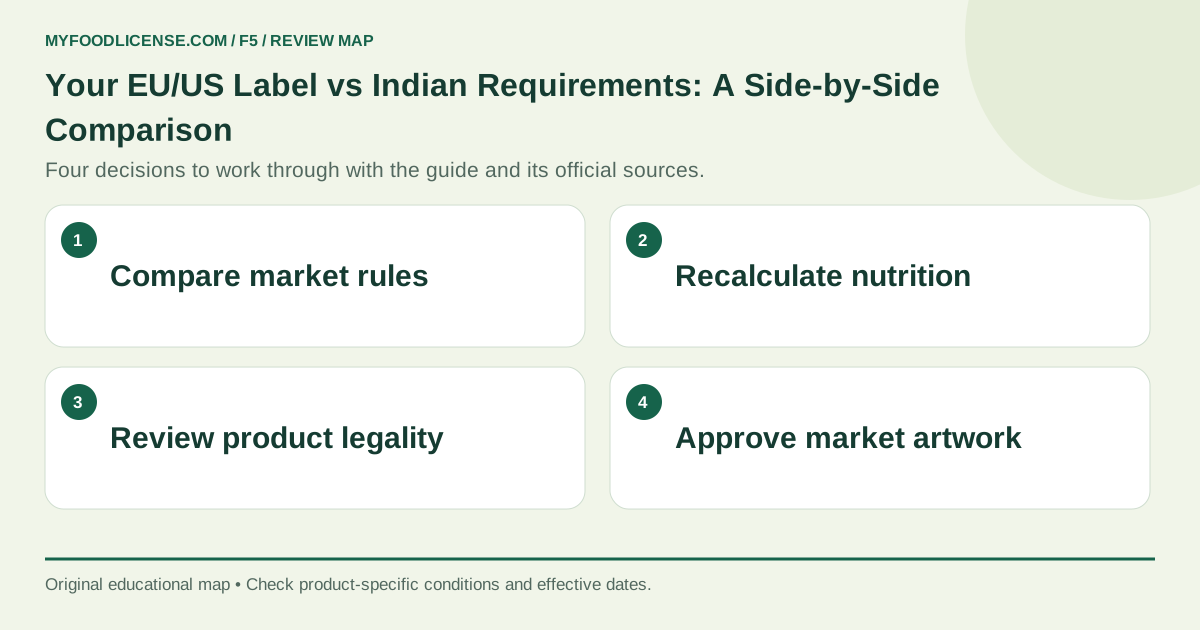
In this guide
A focused comparison
| Area | Overseas reference | Indian review |
|---|---|---|
| Nutrition basis | FDA guidance generally presents Nutrition Facts per serving, with specified package presentations | Review the Indian 100 g/100 ml or single-consumption-pack basis and required per-serve reference contributions |
| Allergens | US major-allergen framework includes sesame; EU overview lists fourteen allergens | Use the Indian prescribed list, declarations and exemptions for the actual product |
| Symbols and businesses | Home-market marks and business details serve that market | Review applicable vegetarian/non-vegetarian symbol, FSSAI details and importer information |
| Commercial declarations | Foreign price and quantity presentation | Review Indian net quantity, MRP, consumer care and applicable unit sale price |
These are selected review differences, not a complete comparative legal opinion. FDA serving guidance; US allergen framework; EU allergen overview.
Do not copy nutrient percentages
A foreign daily-value column is not automatically the Indian required reference calculation. Keep original analytical data, convert units where needed and calculate on the applicable basis. Serving quantities and preparation instructions must remain consistent. Read Indian labelling requirements.
Review ingredient and claim legality too
The foreign pack may use ingredients, additives or claims requiring a different Indian assessment. Translation and added importer details cannot resolve those gaps. Review the formula before declaring the adaptation a design-only task. Read ingredient differences.
Control market variants
Prepare a comparison matrix with current foreign copy, applicable Indian provision, proposed change and evidence owner. Preserve approved market-specific files. A single global artwork needs justification for every market rather than an assumption that the longest allergen list or most detailed panel fits all rules.
Complete the physical proof
Check the adapted label on the actual pack, including date coding and sticker placement if relevant. Resolve pre-dispatch printing and any limited port correction separately. An India-ready PDF should be supported by a formulation, source-data and declaration review.
A worked example
Hypothetical example
A US snack’s label declares values per a 30 g serving. The Indian adaptation uses reliable product data to prepare the applicable Indian basis and reference column, then reviews allergens, symbols and importer information separately. It does not merely retitle the foreign Nutrition Facts box.
Your practical checklist
- Create a market-by-market gap matrix.
- Recalculate nutrition on the Indian basis.
- Review the prescribed Indian allergen treatment.
- Assess ingredients and claims separately.
- Add applicable business and commercial details.
- Control market variants and actual-size proofs.
Download this preparation checklist
For help applying this review to your business, explore our Regulatory Gap Assessment – India vs Overseas Label service. Bring the documents described above so the consultation can focus on the decisions still unresolved.
Frequently asked questions
Is a US Nutrition Facts panel automatically valid in India?
No. Check Indian basis, fields and reference requirements.
Are allergen lists identical across markets?
No. The cited US, EU and Indian frameworks differ.
Can translation alone make a foreign label compliant?
No. Content, formula and presentation need assessment.
Can one global artwork serve all markets?
Only after a justified review of every applicable market requirement.
Does India adaptation guarantee port clearance?
No. Shipment documents, product condition and the clearance process also matter.
Official sources and further reading
Checked on 2 October 2026. Gazette notifications and operative directions prevail over compilations and summaries, including this guide.
- Labelling and Display Regulations compendium, Version VIII, 9 September 2025: Regulation 5: retail declarations, nutrition, dates and allergens. Read alongside later amendments and directions.
- Department of Consumer Affairs: packaged-commodity declarations: Net quantity, MRP including taxes, consumer care and unit sale price overview.
- FDA serving-size and Nutrition Facts guidance: US serving-based presentation; comparison aid, not Indian legal basis.
- FDA major food allergens, including sesame: US nine-major-allergen framework; distinguish from the Indian list.
- European Commission allergen declaration overview: EU fourteen-allergen and emphasis overview; not assumed interchangeable with Indian rules.
- Food Import Regulations compendium, Version III, 12 November 2021: Importer licence and IEC, clearance framework and restricted label rectification. Read with the 2025 amendment and current orders.
This guide is general information, not legal advice; the right route depends on your product and business facts. Examples marked hypothetical are illustrations, not client cases. MyFoodLicense is an independent consultancy and is not affiliated with FSSAI; applications are decided by the competent authority on the official FoSCoS portal.