Imported food
Allowed Abroad, Not Allowed in India: Additives and Ingredients to Watch
An ingredient or additive allowed abroad is not automatically permitted in India. Match the exact material, Indian category, intended use and level to an applicable provision or approval. The key risk is a missing legal basis, not simply a foreign-sounding ingredient name.
By the MyFoodLicense team Sources checked 2 min read
In this guide
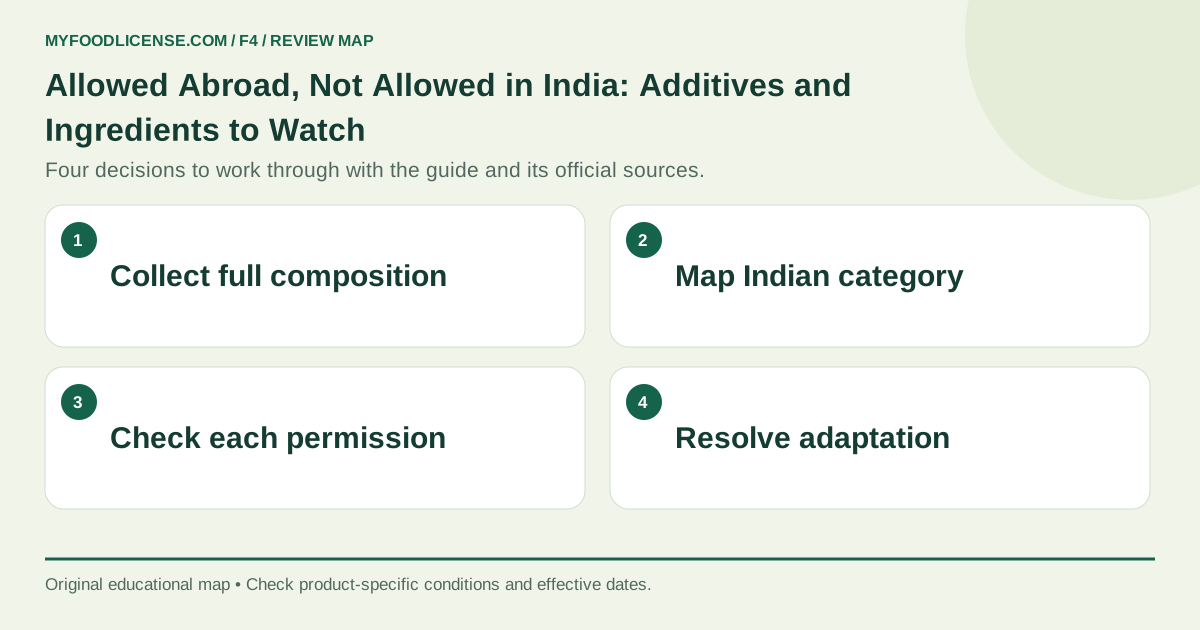
Build the complete formulation inventory
List direct ingredients, compound components, flavours, carriers, processing aids and nutrient sources. Record specifications and final doses. A foreign label can omit details needed for the Indian assessment, so obtain the actual manufacturer’s composition evidence.
Check additive category and level differences
Compare the Indian subcategory, additive entry, maximum level and footnotes. The same INS or other international identifier does not make permissions universal. Sum contributions from premixes and direct addition. Read Indian permissions.
Review botanicals and nutrient forms
Species, plant part, extract process, marker concentration and chemical form can materially change the status. A familiar herb or vitamin name does not settle every derivative. Specialised supplement conditions must be read for the proposed Indian use. Read specialised provisions.
Distinguish evidence from approval
A foreign safety review, history of use or supplier declaration can support a dossier, but does not replace a required Indian prior approval. Public approval lists also require a scope check. Do not treat pending applications as permissions. Read approval workflow.
Choose adaptation before shipment
Where the basis is absent or conditions are not met, consider a supported Indian formula, an approval route or another product. Record the decision and its effect on name, nutrition, allergens and claims. A label-only adaptation should not conceal a product-composition gap.
A worked example
Hypothetical example
A foreign drink’s stabiliser is permitted in its home-market category. The Indian review identifies the actual beverage subcategory and checks its own additive entry and notes. It decides whether the recipe is suitable before the importer orders an India sticker.
Your practical checklist
- Obtain full composition beyond the retail label.
- Identify exact materials and final doses.
- Check Indian categories, entries and notes.
- Review specialised source and form conditions.
- Resolve approval gaps and decision scope.
- Adapt formulation before shipment where needed.
Download this preparation checklist
For help applying this review to your business, explore our Ingredient / Additive Compliance Assessment service. Bring the documents described above so the consultation can focus on the decisions still unresolved.
Frequently asked questions
Is an international additive number enough?
No. Indian category, level and conditions must fit.
Can foreign GRAS or other status replace Indian review?
No. Establish the applicable Indian basis separately.
Are familiar botanicals always permitted?
Not in every form, dose or category.
Can a sticker resolve a formula gap?
No. Product composition and label adaptation are separate.
Should the exporter provide full specifications?
Yes. They are needed for a defensible ingredient and additive assessment.
Official sources and further reading
Checked on 2 October 2026. Gazette notifications and operative directions prevail over compilations and summaries, including this guide.
- Food additive permissions: Appendix A: Category-specific additive limits, notes and restrictions; read later amendments.
- Operationalised supplement provisions, 29 March 2022 direction: Definitions, schedules, dosage, category-specific warnings and product requirements; read with later directions.
- Approval for Non-Specified Food and Food Ingredients Regulations, compendium dated 14 October 2022: Prior approval, application evidence and sequence of product approval followed by licensing. No universal approval-time promise.
- FSSAI order of 6 May 2026: ePAAS single-window approvals: Exclusive ePAAS submission from 1 June 2026 for specified approval and notification routes.
This guide is general information, not legal advice; the right route depends on your product and business facts. Examples marked hypothetical are illustrations, not client cases. MyFoodLicense is an independent consultancy and is not affiliated with FSSAI; applications are decided by the competent authority on the official FoSCoS portal.