Labelling & packaging
How to Make a Nutrition Information Table for Your Label
Build the nutrition table from reliable product data on the reporting basis required for the food. Check the recipe version, serving size, units and applicable RDA contribution. A laboratory report cannot simply be pasted onto a label without interpreting its basis and scope.
By the MyFoodLicense team Sources checked 3 min read
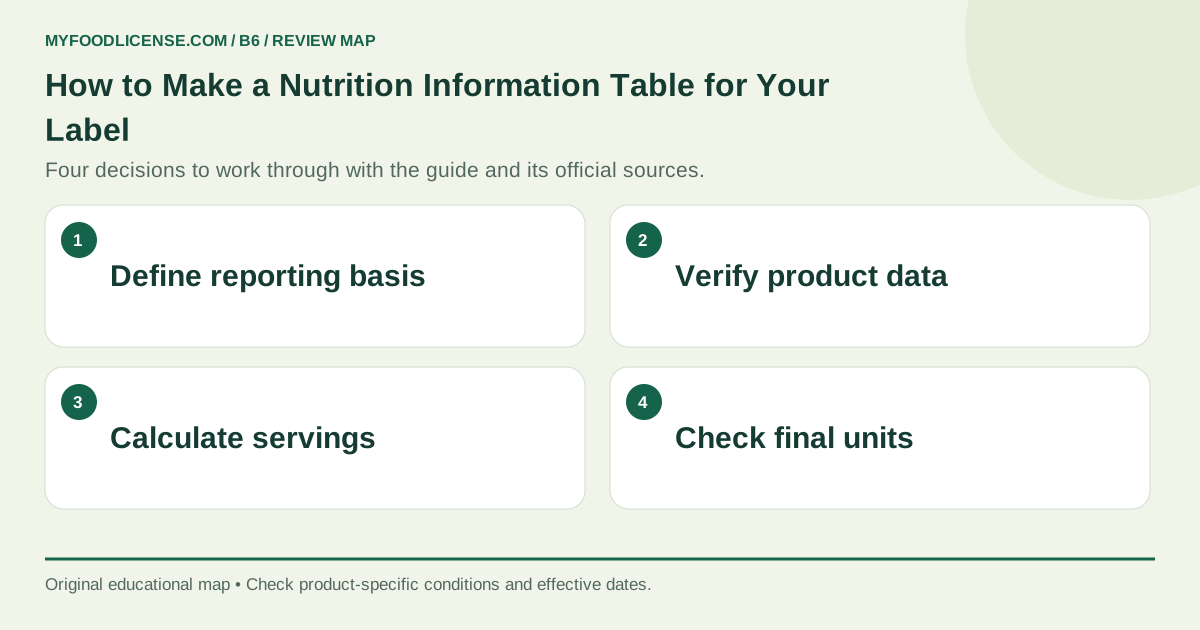
In this guide
Define the reporting basis
The general provisions address information per 100 g, 100 ml or single-consumption pack, together with per-serve percentage contribution to the specified reference requirements. Establish whether the product is reported as sold or under a relevant preparation instruction and category rule. Read nutrition requirements.
Identify the required nutrients
Assess energy, protein, carbohydrate, total and added sugars, fat-related declarations and sodium under the applicable provisions. Saturated fat, trans fat and cholesterol have specific conditions. Claimed nutrients and specialised categories can add requirements. Do not delete a field merely because a generic template omits it.
Prepare the calculation file
Use the actual recipe and appropriate analysis or justified data. Record units, moisture basis, preparation instructions and the difference between total and added sugars. A total-sugar test alone does not determine added sugar from the manufacturing formula. Keep supplier composition and recipe records available.
Calculate serving information transparently
For a hypothetical food with 400 kcal per 100 g, a 25 g serving supplies 100 kcal. On a 2000 kcal adult reference basis, that represents 5% of daily energy. This arithmetic example illustrates scaling only; other nutrients use their own prescribed reference values and conditions.
Check exceptions and future changes
Apply nutrition exemptions only where the product fits the rule, remembering that claims can affect the position. The March 2026 amendment includes changes with a 1 July 2027 effective date. Record current and future versions separately rather than treating every notified amendment as immediately operative. Read the effective date.
A worked example
Hypothetical example
A beverage report states sodium in mg per 100 ml, but artwork labels the same number as grams per serving. The review converts units and serving quantities, then rechecks the RDA column. The analytical value was correct; the label interpretation was not.
Your practical checklist
- Confirm recipe and reporting basis.
- Identify required and claimed nutrients.
- Review analytical and formulation evidence.
- Check units and serving conversions.
- Use the correct nutrient-specific reference values.
- Verify exemptions and effective dates.
Download this preparation checklist
For help applying this review to your business, explore our Nutrition Information Review service. Bring the documents described above so the consultation can focus on the decisions still unresolved.
Frequently asked questions
Can I copy another product’s panel?
No. Nutrition information must reflect your actual product and applicable requirements.
Does a test report prove added sugar?
Not by itself. Added-sugar assessment also depends on formulation and source data.
Is sodium the same as salt?
No. Use the prescribed declaration and any justified conversion carefully.
Can I omit all nutrition for a small pack?
Assess the specific exemption and conditions; pack size alone is not a complete answer.
When do the cited March 2026 changes apply?
The notification specifies 1 July 2027 for its provisions.
Official sources and further reading
Checked on 2 October 2026. Gazette notifications and operative directions prevail over compilations and summaries, including this guide.
- Labelling and Display Regulations compendium, Version VIII, 9 September 2025: Regulation 5: retail declarations, nutrition, dates and allergens. Read alongside later amendments and directions.
- Labelling and Display First Amendment Regulations, 24 March 2026: Effective 1 July 2027; infant-nutrition RDA declarations, nutrition exemptions and non-retail containers. Do not describe as already effective in October 2026.
This guide is general information, not legal advice; the right route depends on your product and business facts. Examples marked hypothetical are illustrations, not client cases. MyFoodLicense is an independent consultancy and is not affiliated with FSSAI; applications are decided by the competent authority on the official FoSCoS portal.