Imported food
Imported Food Labels in India: Language Rules and Permitted Stickers
Imported food needs an India-specific label assessment before shipment. The general language provision permits English or Hindi in Devanagari, subject to applicable requirements. Port stickers are allowed only for the specified rectifiable deficiencies under supervision; they are not a general replacement label.
By the MyFoodLicense team Sources checked 3 min read
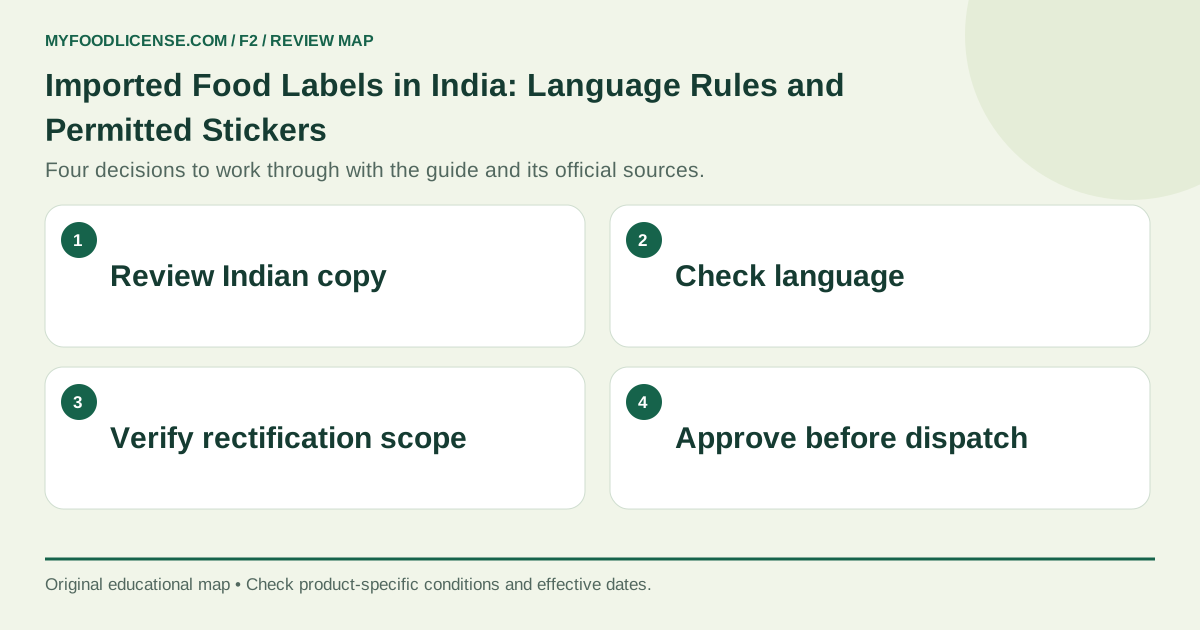
In this guide
Review the whole Indian declaration set
Assess food identity, ingredients, additives, allergens, nutrition, relevant symbols, business and importer information, country of origin, dates and commercial declarations. Apply product-specific rules as well as general labelling. A foreign-market pack may be complete for its own market and still need Indian adaptation. Read Indian label requirements.
Apply the language rule accurately
The general provision addresses English or Hindi in Devanagari; additional languages must not contradict required information. Review the actual declaration and specialised provisions. Translating a brand tagline does not fix missing nutrition, warning or business data.
Understand permitted rectification
The import regulations and later directions identify the limited rectifiable label deficiencies. Common listed areas include importer details, the relevant FSSAI logo/number and applicable vegetarian/non-vegetarian identification, subject to the exact current permission. Establish the allowed scope for the defect rather than assuming a sticker may replace ingredients or dates. Read rectification provisions.
Follow controlled sticker conditions
The framework requires the applicable corrections in the Customs-bonded setting under the authorised officer’s supervision, using the specified non-detachable presentation without masking original information. Obtain the actual instruction and retain before-and-after evidence. A supplier’s preprinted sticker proposal is not proof that the port will permit it.
Adapt before dispatch wherever possible
Agree complete India copy with the foreign manufacturer before the shipment leaves. Check the sticker or printed label at actual size against the physical pack. Review recipe and Indian claims as well; a perfectly placed sticker cannot legalise an unpermitted ingredient. Read ingredient differences.
A worked example
Hypothetical example
A foreign snack has an unfamiliar nutrition basis and lacks importer details. The importer separates the full India label redesign from any limited port-rectification question. It resolves the nutrition and recipe assessment before dispatch rather than assuming all content can be added after arrival.
Your practical checklist
- Assess all Indian declarations.
- Check language and translation consistency.
- Identify the exact alleged deficiency.
- Verify whether correction is permitted.
- Follow authorised bonded-area conditions.
- Approve adapted artwork before dispatch.
Download this preparation checklist
For help applying this review to your business, explore our India-Specific Label Adaptation service. Bring the documents described above so the consultation can focus on the decisions still unresolved.
Frequently asked questions
Must every imported declaration be English only?
The general rule permits English or Hindi in Devanagari, subject to applicable provisions.
Can I sticker over any foreign label?
No. Assess the permitted deficiency and correction conditions.
Can a sticker fix an unpermitted ingredient?
No. Product compliance is a separate issue.
Should original information be masked?
Follow the prescribed non-masking and non-detachable correction conditions.
Is pre-dispatch adaptation useful?
Yes. It reduces dependence on limited port-rectification permissions.
Official sources and further reading
Checked on 2 October 2026. Gazette notifications and operative directions prevail over compilations and summaries, including this guide.
- Labelling and Display Regulations compendium, Version VIII, 9 September 2025: Regulation 5: retail declarations, nutrition, dates and allergens. Read alongside later amendments and directions.
- Food Import Regulations compendium, Version III, 12 November 2021: Importer licence and IEC, clearance framework and restricted label rectification. Read with the 2025 amendment and current orders.
- FSSAI Southern Region food-import FAQs, 15 January 2020: Shelf-life wording and conceptual checklist. Old contact names, fees and portal UI instructions are not carried into the blogs.
- FSSAI Trade and International Cooperation advisories: Current import directions, including the 10 April 2026 payment-workflow update.
This guide is general information, not legal advice; the right route depends on your product and business facts. Examples marked hypothetical are illustrations, not client cases. MyFoodLicense is an independent consultancy and is not affiliated with FSSAI; applications are decided by the competent authority on the official FoSCoS portal.