Imported food
Importing Food into India: FSSAI Clearance, Labels and Common Rejection Risks
Assess the product and Indian label before the shipment leaves the supplier. An importer licence authorises the business activity; it does not, by itself, establish that every product and consignment is ready for Indian clearance.
By the MyFoodLicense team Sources checked 8 min read
In this guide
- Start with importer eligibility and product status
- Build a pre-shipment document pack
- Assess the Indian label before dispatch
- Can missing declarations be added with stickers?
- Check remaining shelf life at the relevant import stage
- What happens in the FSSAI clearance process?
- Do not use old payment screens as a current procedure
- Common rejection risks to assess early
- Explore the detailed guides
- Frequently asked questions
- Official sources
Start with importer eligibility and product status
The import regulations require the relevant Central importer licence and valid IEC registration with DGFT. They also provide a separate clearance framework for food consignments. Read the importer licensing provisions.
Prepare two files: one describing the importer business and another describing each product proposed for import. The first establishes the operator; the second records the formulation, product identity, Indian regulatory route and planned label.
Ask the supplier for complete formulation and specification information early. A consumer-facing ingredient list may be insufficient for the product assessment. Collect the components of mixes, coatings, flavour systems and other compound ingredients that could affect the review.
Review the status of the ingredients and additives against the Indian product route. If the product is a supplement, a specialised nutrition food or includes an uncertain ingredient, resolve that question before relying on an ordinary-food launch plan. The classification guide explains the questions to establish.
Include the proposed advertising as well. A foreign label may describe the product using terms that raise separate Indian claims questions. Record the actual wording and intended channels so the reviewer can assess the complete launch concept.
Build a pre-shipment document pack
The official import manual describes the Customs and food-clearance documentation framework. Match the required documents to the product, consignment and live process, including conditional certificates or approvals where relevant. Read the Food Imports Manual.
| Evidence group | Preparation task |
|---|---|
| Importer credentials | Reconcile legal entity, licence, IEC and the entity on shipment papers. |
| Product information | Collect ingredient components, specifications and the original label. |
| Shipment papers | Coordinate the Bill of Entry, origin information, invoice and packing details as applicable. |
| Conditional documents | Establish any product approval or category-specific certificate question. |
| Batch and dates | Record which batches are shipped and the relevant date information. |
| Indian artwork | Keep the original and revised label versions with the review decision. |
Use one SKU-to-shipment spreadsheet. Match each product description, batch, quantity and pack to the supplier documents. If the description differs between the invoice and the pack, resolve why before the shipment is dispatched.
Give the customs broker and supplier a common document checklist. Agree who provides each item, who reviews it and when the dispatch decision will be made. This avoids discovering missing product information only after the consignment arrives.
Download the pre-shipment review checklist
Assess the Indian label before dispatch
Review the foreign artwork in the context of the Indian product route. Establish the food name, declarations, business details, date presentation and proposed claims. Check the required language treatment and any product-specific statements rather than assuming a foreign-market label translates directly.
The label review needs both the original pack and the planned adaptation. Keep a marked-up comparison showing the change, the reason and the affected panel. This helps the supplier and designer implement corrections without accidentally removing other important information.
Imported labels should also be assessed alongside the current Labelling and Display requirements. Read the general label rules alongside the import provisions.
Hypothetical label review
A supplier's front panel emphasises a nutrient claim, while the evidence supplied relates to a different formulation. The importer should obtain the correct evidence and review the claim before approving Indian artwork. A label translation would not settle that underlying issue.
myfoodlicense.com provides import-product assessment and imported-label review. The review is most useful while the supplier can still change the product file or packaging plan.
Can missing declarations be added with stickers?
The import regulations allow specified rectifiable labelling deficiencies to be corrected through the authorised customs-area process. The provision is limited and includes conditions such as not masking the original information. Read current directions with the base regulation. See regulation 6 and permitted rectification.
Before choosing a sticker strategy, prepare a list of the proposed corrections and establish which process permits them. Record the location, method and responsible person. Obtain the current instructions relevant to the actual consignment.
A sticker can supply particular information where permitted. It cannot change what ingredient was used, create a missing approval or make an unsupported claim evidence-based. Distinguish a presentation issue from a substantive product issue in the review file.
Ask the supplier to supply high-resolution panel images and actual pack dimensions. The person assessing a proposed sticker needs to see what it will cover, where it can fit and whether the original information remains readable. A mock-up made without the actual pack may conceal practical problems.
Check remaining shelf life at the relevant import stage
The official import FAQ describes the minimum balance as 60% of shelf life or three months before expiry, whichever is less, at import. It defines the relevant date and shelf-life concepts; verify the applicable product and calculation basis. Read the official shelf-life wording.
Build a batch-level date sheet before booking transport. Record manufacture information, the applicable expiry or best-before date, the product's shelf-life basis and expected arrival. Have the relevant reviewer check the calculation rather than treating a supplier's statement of “long shelf life” as sufficient.
Hypothetical simplified arithmetic
For an assumed total shelf life of 120 days, 60% is 72 days. Comparing that with the three-month limb illustrates why the shorter requirement must be identified. A live assessment must use the actual printed dates, applicable definition and import-date basis rather than this rounded teaching example.
Do not schedule the shipment so tightly that a modest delay removes the commercial selling window. The regulatory calculation and the business's useful sale period are separate planning questions. Work backwards from realistic transport, review and distribution needs.
What happens in the FSSAI clearance process?
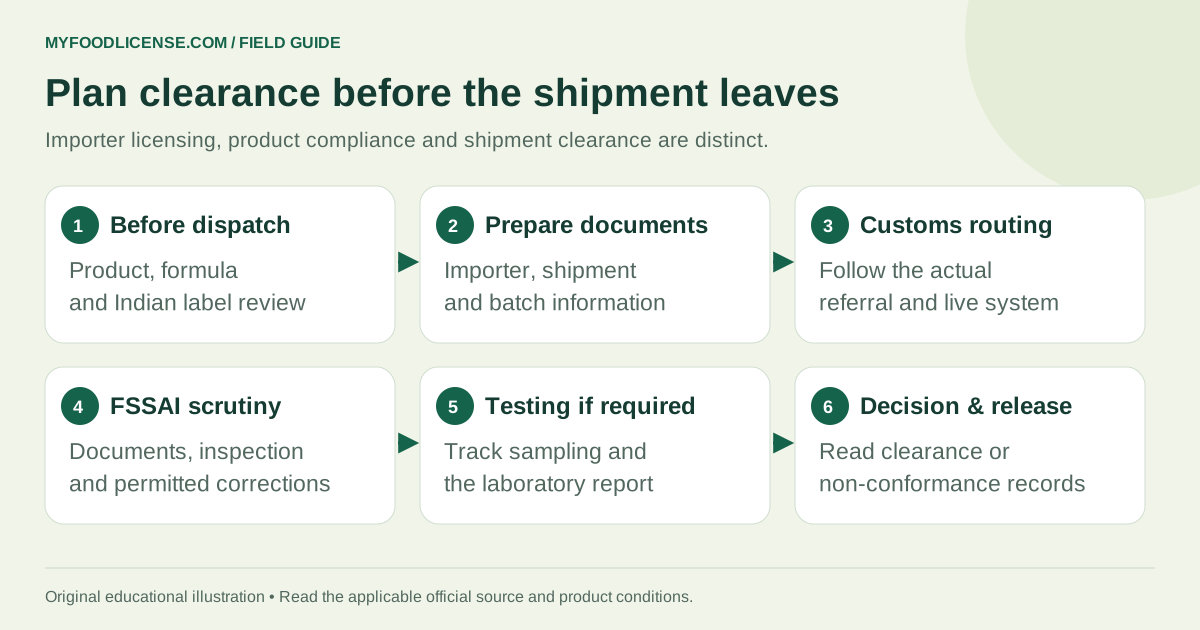
At a high level, the official manual describes Customs referral where applicable, document scrutiny, visual inspection, sampling/testing where required and the clearance or non-conformance decision. Routing can reflect risk assessment and the current system. Read the official clearance workflow.
- Prepare the Customs filing. Ensure the product descriptions and consignment documents match the shipped goods.
- Follow the actual referral. Confirm the current Customs/SWIFT and food-clearance workflow used for the shipment.
- Answer document questions. Provide a factual response supported by the relevant product or shipment evidence.
- Facilitate inspection. Coordinate access to the shipment and preserve the identity of each batch.
- Track testing where required. Keep sampling and laboratory records with the consignment file.
- Review the decision. Understand what the issued clearance or non-conformance document applies to.
This is a process overview, not a promise of universal sampling, identical screens or a fixed clearance time. Check current official instructions through the import advisories directory.
Do not use old payment screens as a current procedure
The April 2026 official update describes payment flexibility after visual inspection but before the relevant P-NOC, NOC or NCR generation. Review the current account workflow for the consignment. Official update on import-payment workflow.
Keep a payment log showing the charge requested, consignment reference, payer and acknowledgement. Do not copy historic testing amounts or assume a payment sequence from an old tutorial. Confirm what the current system requests and the applicable official basis.
Likewise, check later import and laboratory amendments before making process decisions. The official notifications directory distinguishes final notifications from drafts. Use that distinction when updating the shipment checklist.
Common rejection risks to assess early
Use a risk register with one row per unresolved issue. Product status, ingredient identity, claim evidence, label adaptation, date calculations and document consistency should each have an owner. Treat “awaiting supplier information” as an open task, not as a completed review.
If a problem is raised at the port, read the actual reason and document before choosing a response. Establish whether it concerns paperwork, a permitted rectification, a test result or the product itself. Each may need a different evidence set and procedure.
Keep the original consignment records and any communication intact. Seek advice on the available route and applicable deadline promptly, using the decision received. Do not assume that a sticker, a new commercial description or a fresh test can answer every form of non-conformance.
The most useful time to resolve an import question is often before dispatch, when information and commercial choices remain easier to change. Use the label guide and the claims guide with the product assessment to build one coherent pre-shipment decision file.
Explore the detailed guides
Use these focused articles to work through the decisions relevant to your business.
- FSSAI Import Clearance Explained: From Shipment to Release
- Imported Food Labels in India: Language Rules and Permitted Stickers
- Why Imported Food Gets Rejected at the Port (and How to Avoid It)
- Allowed Abroad, Not Allowed in India: Additives and Ingredients to Watch
- Your EU/US Label vs Indian Requirements: A Side-by-Side Comparison
Frequently asked questions
Does an FSSAI importer licence guarantee consignment clearance?
The licence and the product/consignment assessment are separate. Clearance depends on the applicable requirements and the consignment's actual condition and evidence.
Can I fix every Indian label problem with a sticker?
Assess the permitted rectifications and the authorised process. A sticker cannot cure a substantive ingredient, product-approval or claim-evidence problem.
Is a product allowed in India because it is sold in the US or EU?
Establish the Indian regulatory basis, product route and applicable conditions. Overseas sale is background information, not a complete domestic assessment.
Will every consignment be tested in the same way?
Actual routing and sampling depend on the applicable process and consignment. Check the current referral, instructions and official requirements.
What should I send for a pre-shipment review?
Provide the complete formulation, specifications, original and proposed Indian labels, importer details, batch dates, shipment documents and any existing approval or authority communication.
Official sources and further reading
Checked on 2 October 2026. Gazette notifications and operative directions prevail over compilations and summaries, including this guide.
- Food Import Regulations compendium, Version III, 12 November 2021: Importer licence and IEC, clearance framework and restricted label rectification. Read with the 2025 amendment and current orders.
- FSSAI Food Imports Manual: Document scrutiny, inspection, sampling, NOC and non-conformance workflow; current Customs/SWIFT implementation may alter screens.
- FSSAI Southern Region food-import FAQs, 15 January 2020: Shelf-life wording and conceptual checklist. Old contact names, fees and portal UI instructions are not carried into the blogs.
- FSSAI Trade and International Cooperation advisories: Current import directions, including the 10 April 2026 payment-workflow update.
- FSSAI monthly achievements: April 2026: Cross-check for updated fees and 10 April 2026 import-payment workflow. Official indexed PDF content was accessible although direct fetching was inconsistent.
- FSSAI official food-law notifications: Final versus draft changes and newer import/laboratory amendments.
- Labelling and Display Regulations compendium, Version VIII, 9 September 2025: Regulation 5: retail declarations, nutrition, dates and allergens. Read alongside later amendments and directions.
This guide is general information, not legal advice; the right route depends on your product and business facts. Examples marked hypothetical are illustrations, not client cases. MyFoodLicense is an independent consultancy and is not affiliated with FSSAI; applications are decided by the competent authority on the official FoSCoS portal.