Labelling & packaging
Declaring Food Additives on a Label: Class Titles and INS Numbers
An additive label declaration generally combines the functional class with its specific name or recognised INS number. The declaration must describe an additive actually present and used appropriately. An INS number identifies a substance; it does not establish permission in every food.
By the MyFoodLicense team Sources checked 3 min read
In this guide
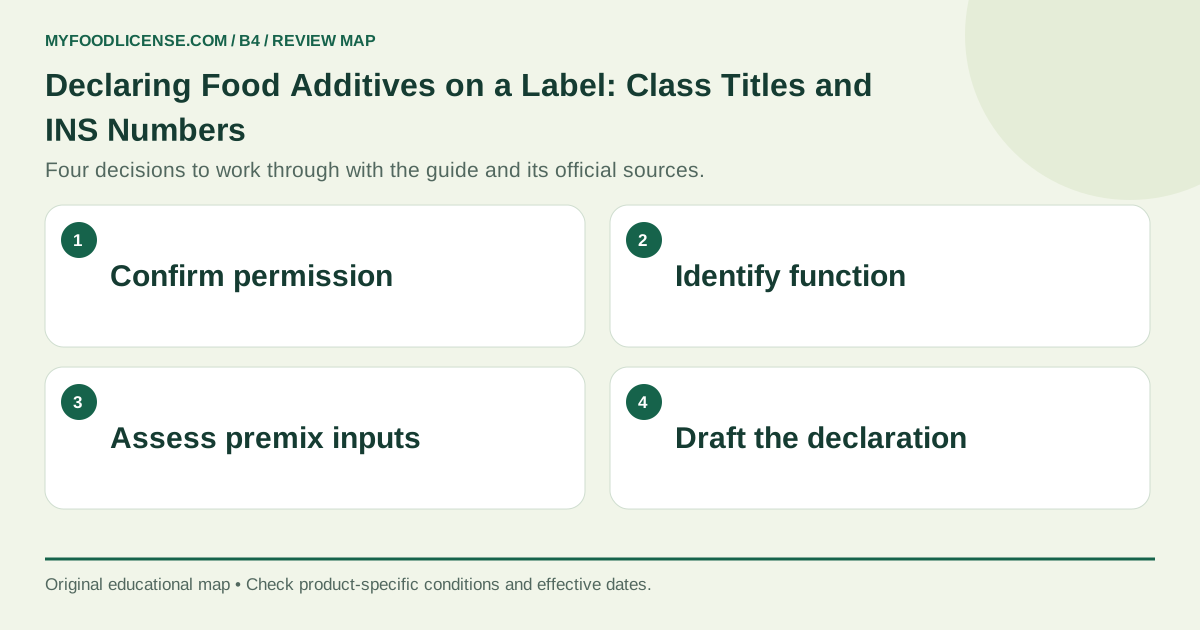
Separate permission from declaration
First identify the food category and applicable additive entry, level and notes. Only then draft the label. A correct-looking INS declaration cannot legalise an additive that is not permitted in the product. Read category-specific additive permissions.
Identify the actual technological function
Establish whether the ingredient functions as an acidity regulator, preservative, stabiliser, emulsifier or another applicable class in the finished product. Use the actual role and prescribed terminology rather than whichever class sounds reassuring. The Labelling and Display rules require the class together with the name or recognised INS identifier. Read additive declarations.
Read supplier premix specifications
Seasonings, fillings and colours may introduce several additives or carriers. Check their identities, concentrations and functions. A trade name such as flavour blend or texture system is insufficient to determine every applicable declaration or carry-over question.
Assess carry-over and processing aids carefully
The additive framework has conditions for carry-over. Establish the source, amount and whether a technological function remains in the final food. Do not omit an additive solely because it arrived through another ingredient. Processing-aid treatment also requires the actual substance and use to fit the relevant provision. Read the additive framework.
Check the final recipe and artwork together
Record the decision for each additive and its final wording. Recheck the list when the supplier, dose or food category changes. Keep nutrition and allergen implications in the same review where relevant, without treating additive declarations as an isolated label-design task.
A worked example
Hypothetical example
A drink manufacturer receives a preservative through a fruit preparation. It calculates the contribution and reviews the function in the finished drink before deciding on the label. The supplier’s ingredient list is evidence, but the final-product assessment determines the applicable declaration.
Your practical checklist
- Identify substance and recognised identifier.
- Confirm category permission and relevant level.
- Determine the finished-product function.
- Review premix contribution and carry-over.
- Draft class plus name or INS wording.
- Retain the formulation and label decision.
Download this preparation checklist
For help applying this review to your business, explore our Additive Declaration Review service. Bring the documents described above so the consultation can focus on the decisions still unresolved.
Frequently asked questions
Is an INS number proof of permission?
No. Permission depends on the category, conditions and level.
Can I declare only the number?
Review the required functional-class plus name or INS presentation.
What if the additive comes from a premix?
Assess its contribution, function and any carry-over conditions.
Can one additive have different functions?
Its label class should reflect the applicable actual function in the food.
Are processing aids automatically omitted?
No. Establish the relevant classification and conditions before deciding.
Official sources and further reading
Checked on 2 October 2026. Gazette notifications and operative directions prevail over compilations and summaries, including this guide.
- Labelling and Display Regulations compendium, Version VIII, 9 September 2025: Regulation 5: retail declarations, nutrition, dates and allergens. Read alongside later amendments and directions.
- Food additive permissions: Appendix A: Category-specific additive limits, notes and restrictions; read later amendments.
- Food standards chapter 3: substances added to food: Additive framework, flavour definitions and carry-over principles.
This guide is general information, not legal advice; the right route depends on your product and business facts. Examples marked hypothetical are illustrations, not client cases. MyFoodLicense is an independent consultancy and is not affiliated with FSSAI; applications are decided by the competent authority on the official FoSCoS portal.