Classification & formulation
Flavours on Food Labels: Natural, Nature-Identical and Artificial
Flavour permission and label wording need the actual flavour specification and food category. Natural, nature-identical and artificial describe different regulatory concepts. A supplier’s branded flavour name does not establish the correct classification or consumer-facing declaration.
By the MyFoodLicense team Sources checked 2 min read
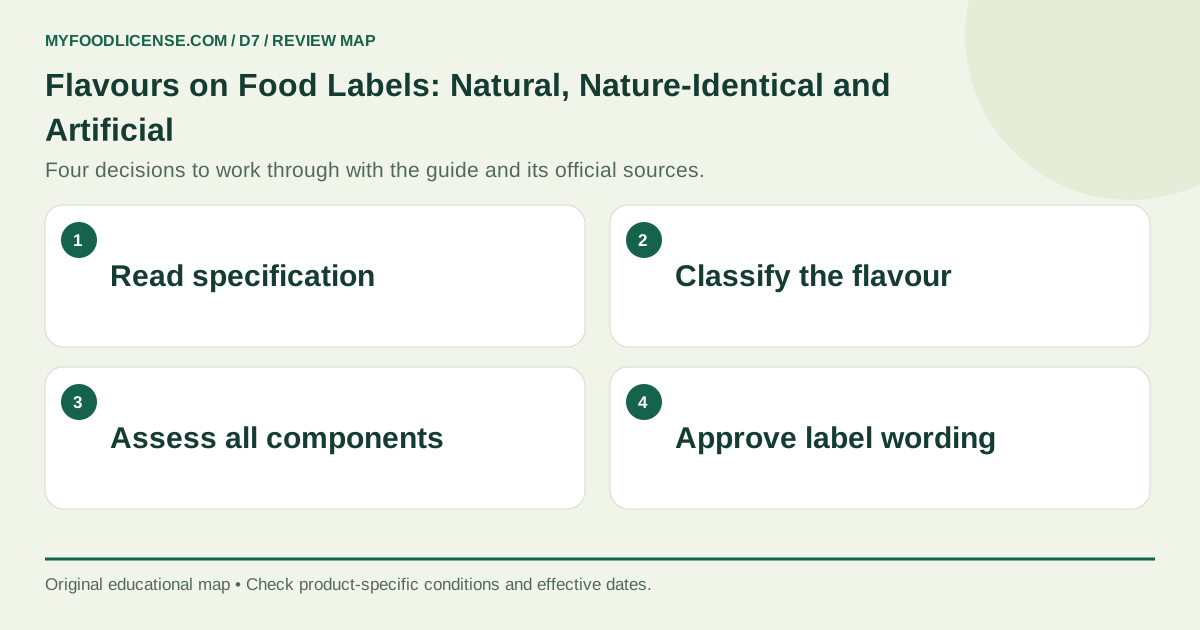
In this guide
Obtain the complete flavour specification
Ask for the flavouring substances, source, preparation method, carriers, solvents and relevant additives. A specification should distinguish the flavour classification from a sales phrase such as authentic strawberry taste. Resolve missing composition information before approving a natural representation.
Check the relevant definitions and use
Read the substances-added-to-food framework and product-specific restrictions. Determine the actual material’s classification and permitted use in the proposed food. Do not assume a flavour preparation permitted abroad is automatically allowed in every Indian category. Read flavour definitions and conditions.
Draft the prescribed declaration
The Labelling and Display provisions address added-flavour declarations and the relevant class or descriptors. Match the wording to the actual material and category. Keep the ingredient-list assessment alongside any additional prescribed statement. Read added-flavour labelling.
Review carriers, allergens and identity
Milk, soy or other relevant inputs can arrive through a flavour system. Check additive contribution and allergen status rather than treating the flavour as a single opaque ingredient. Fruit imagery and a product name must remain accurate where the product is flavoured rather than made with the depicted fruit.
Control sourcing and claims
Record the supplier specification, legal assessment and approved wording. Changing the flavour supplier can alter carriers, classification and declarations while the sensory profile stays similar. A natural-flavour decision does not automatically support all-natural for the complete food. Review natural claims.
A worked example
Hypothetical example
A biscuit uses a vanilla-style flavour whose trade name suggests natural origin. Its detailed specification identifies a different flavour classification and a milk-derived carrier. The brand revises the declaration and allergen assessment instead of approving copy from the invoice name.
Your practical checklist
- Collect the full flavour composition.
- Check classification and permitted use.
- Review product-specific conditions.
- Draft applicable added-flavour wording.
- Assess carriers and allergen inputs.
- Recheck sourcing changes and overall claims.
Download this preparation checklist
For help applying this review to your business, explore our Flavour Regulatory Review service. Bring the documents described above so the consultation can focus on the decisions still unresolved.
Frequently asked questions
Is a trade name proof that flavour is natural?
No. Review source, process and actual specification.
Are nature-identical and natural interchangeable?
No. Apply the relevant definitions.
Can a flavour introduce allergens?
Yes. Its carriers and components need assessment.
Does natural flavour make the whole food natural?
Not automatically. Assess the complete product claim.
Should supplier substitutions trigger review?
Yes. Composition and regulatory classification may change.
Official sources and further reading
Checked on 2 October 2026. Gazette notifications and operative directions prevail over compilations and summaries, including this guide.
- Food standards chapter 3: substances added to food: Additive framework, flavour definitions and carry-over principles.
- Labelling and Display Regulations compendium, Version VIII, 9 September 2025: Regulation 5: retail declarations, nutrition, dates and allergens. Read alongside later amendments and directions.
- Advertising and Claims Regulations compendium, Version IV, 14 December 2022: Nutrition-claim thresholds and general claim conditions. Protein uses RDA-based alternatives, not a universal percentage-of-energy rule.
This guide is general information, not legal advice; the right route depends on your product and business facts. Examples marked hypothetical are illustrations, not client cases. MyFoodLicense is an independent consultancy and is not affiliated with FSSAI; applications are decided by the competent authority on the official FoSCoS portal.