Classification & formulation
Food Additives in India: Permitted Lists and Maximum Levels
Food-additive compliance depends on the actual substance, food category, final concentration and all applicable notes. INS identification alone is insufficient. Calculate contributions from direct addition and compound ingredients before comparing the finished product with the permitted conditions.
By the MyFoodLicense team Sources checked 2 min read
In this guide
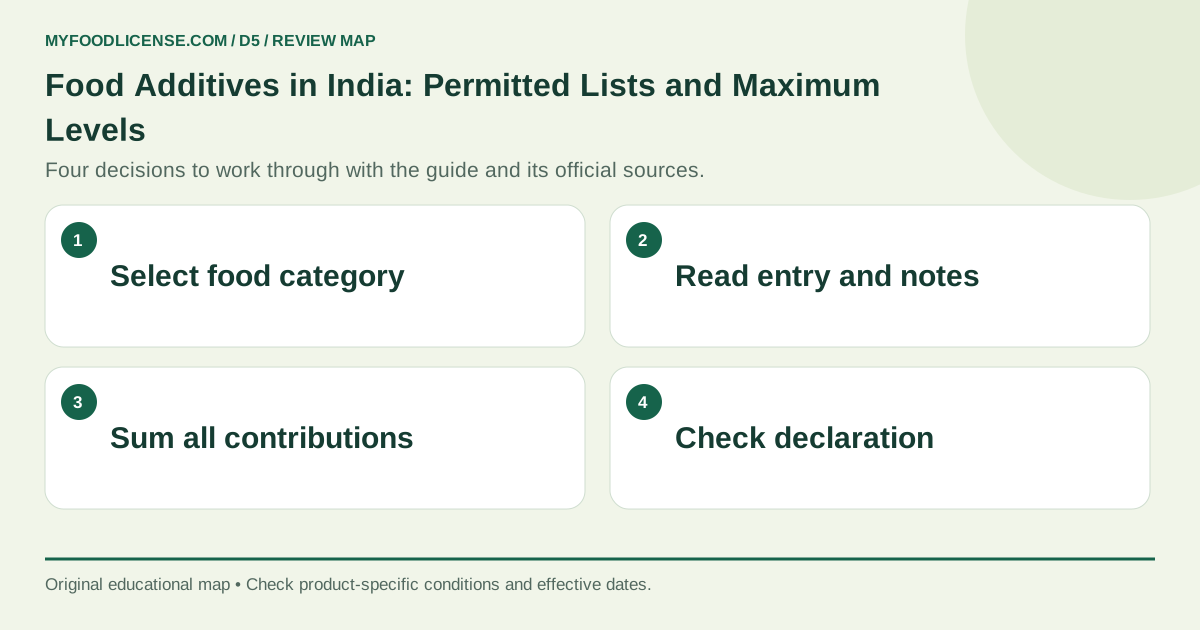
Choose the product category first
Use the actual food and applicable subcategory. Read the product standard and any specialised rules alongside Appendix A. An additive permitted in confectionery is not automatically permitted in a supplement, beverage or cereal product. Read additive entries.
Read the complete permission
Record the additive identity, level, unit, basis and footnotes. A group limit may apply to several related additives together. Notes can restrict use to particular products or specify how the level is expressed. GMP means use according to the relevant technological need and framework; it is not unlimited addition.
Calculate final-product contributions
For a hypothetical premix added at 2% and containing 1% of an additive, its contribution is 0.02% of the finished formula, or 200 mg/kg before any relevant process adjustment. Add other sources and compare on the prescribed basis. This arithmetic does not establish permission or a safe limit for that substance.
Assess carry-over and process effects
Review the conditions for carry-over from ingredients and whether a technological function remains. Processing, moisture change and yield can affect final concentration. Do not compare the premix concentration directly with a limit for the finished food. Read the additive framework.
Connect formulation and label
Once use is established, prepare the correct functional-class and name or INS declaration. Record the supplier specification and calculation version. Reassess changes in premix strength, recipe or category before reusing the compliance result. Read additive label declarations.
A worked example
Hypothetical example
A snack manufacturer checks a preservative added directly but overlooks the same substance in a seasoning. The full calculation sums both sources before comparison with the applicable entry and notes. The ingredient list is reviewed against that total-formulation assessment.
Your practical checklist
- Confirm the food subcategory.
- Identify each additive and source.
- Read limit, units, group basis and notes.
- Calculate finished-product contributions.
- Assess carry-over and process changes.
- Prepare declarations and retain calculations.
Download this preparation checklist
For help applying this review to your business, explore our Additive Compliance Review service. Bring the documents described above so the consultation can focus on the decisions still unresolved.
Frequently asked questions
Is GMP an unlimited allowance?
No. Apply the relevant technological and regulatory conditions.
Can I check only directly added additives?
No. Compound ingredients can contribute additional amounts.
Is mg/kg the same as percent?
No. Convert consistently on the prescribed basis.
Does a permitted INS number apply to every food?
No. Category and conditions matter.
Does correct labelling fix excess use?
No. Permission and concentration must be established first.
Official sources and further reading
Checked on 2 October 2026. Gazette notifications and operative directions prevail over compilations and summaries, including this guide.
- Food additive permissions: Appendix A: Category-specific additive limits, notes and restrictions; read later amendments.
- Food standards chapter 3: substances added to food: Additive framework, flavour definitions and carry-over principles.
- Labelling and Display Regulations compendium, Version VIII, 9 September 2025: Regulation 5: retail declarations, nutrition, dates and allergens. Read alongside later amendments and directions.
This guide is general information, not legal advice; the right route depends on your product and business facts. Examples marked hypothetical are illustrations, not client cases. MyFoodLicense is an independent consultancy and is not affiliated with FSSAI; applications are decided by the competent authority on the official FoSCoS portal.