Launching a food brand
How Much Does It Cost to Make a Food Product Compliant in India?
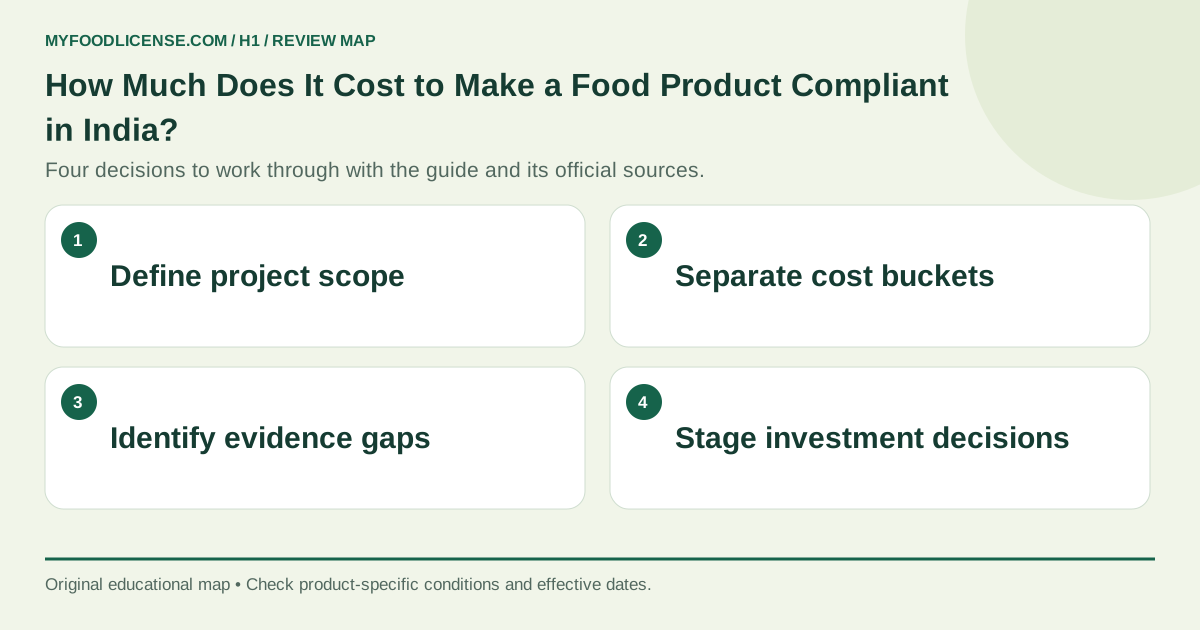
Compliance cost depends on the product, business roles, evidence already available and work still required. Separate official charges, professional scope, testing and artwork or development costs. A single low headline fee cannot explain the budget for every food launch.
By the MyFoodLicense team Sources checked 2 min read
In this guide
Start with the scope
List products, formulas, pack sizes, sites, categories, imports and intended claims. Identify what is already supported by usable documents. A standard snack with established inputs differs from a novel ingredient, supplement or multi-country import project.
Separate the cost buckets
| Budget area | What to establish |
|---|---|
| Official charges | Applicable licence fees and any current approval or other official route charges |
| Regulatory work | Classification, formula, evidence, label, claims and filing scope |
| External evidence | Relevant testing, technical studies or certification where applicable |
| Implementation | Reformulation, packaging trials, revised artwork or printing |
| Continuing work | Applicable returns, testing, updates and ongoing records |
Use current official criteria for fee calculations. Read the fee table.
Avoid duplicate or incomplete quotations
Ask which SKUs, pack variants, claim reviews, query cycles and deliverables are included. Confirm taxes, out-of-pocket costs and work dependent on missing supplier evidence. A quotation for filing alone should not be mistaken for a complete formulation or label assessment.
Budget unresolved regulatory risk early
Where an ingredient or claim needs additional evidence or approval, separate that work from routine launch tasks. Do not assume an approval fee includes the studies or dossier preparation. The ePAAS route is relevant for specified approvals. Read the current framework.
Use a staged decision budget
Start with feasibility, then commit to product development and printing after material questions are resolved. Maintain a contingency tied to identified uncertainties rather than an invented universal percentage. Compare quotations by outcome and documented scope, not just the first line.
A worked example
Hypothetical example
A brand compares a filing-only price with a package covering formula and label review. It creates a scope table and identifies testing and printing as separate costs. The comparison becomes meaningful once both offers are mapped to the same actual project needs.
Your practical checklist
- List SKUs, sites and intended markets.
- Identify usable existing evidence.
- Separate official and professional charges.
- Define testing and certification scope.
- Record exclusions, taxes and query work.
- Budget uncertainties before printing.
Download this preparation checklist
For help applying this review to your business, explore our Complete Regulatory Launch Support service. Bring the documents described above so the consultation can focus on the decisions still unresolved.
Frequently asked questions
Is there one compliance price for every product?
No. Product complexity, roles and evidence gaps change the scope.
Are consultancy fees government fees?
No. They are separate charges for agreed work.
Does an approval fee include testing?
Do not assume so. Define official and evidence costs separately.
Should I print before feasibility review?
Resolve material product and claim uncertainties first.
How should quotes be compared?
Use matching deliverables, SKUs, evidence assumptions and exclusions.
Official sources and further reading
Checked on 2 October 2026. Gazette notifications and operative directions prevail over compilations and summaries, including this guide.
- FoSCoS revised Kind-of-Business eligibility table, 2 April 2026 file: Activity-specific eligibility and annual fees. The PDF itself is marked updated 1 April 2026; relevant rows appear on pages 3, 6, 7 and 9.
- FSSAI order of 6 May 2026: ePAAS single-window approvals: Exclusive ePAAS submission from 1 June 2026 for specified approval and notification routes.
This guide is general information, not legal advice; the right route depends on your product and business facts. Examples marked hypothetical are illustrations, not client cases. MyFoodLicense is an independent consultancy and is not affiliated with FSSAI; applications are decided by the competent authority on the official FoSCoS portal.