Inspections & compliance
FSMS Plan: What FSSAI Expects and How to Write One
An FSMS plan should explain how your actual business identifies and controls food-safety hazards. Connect the process flow, hygiene prerequisites, monitoring, corrective action and records. A copied factory manual or an ISO logo does not establish that the controls suit your operation.
By the MyFoodLicense team Sources checked 2 min read
In this guide
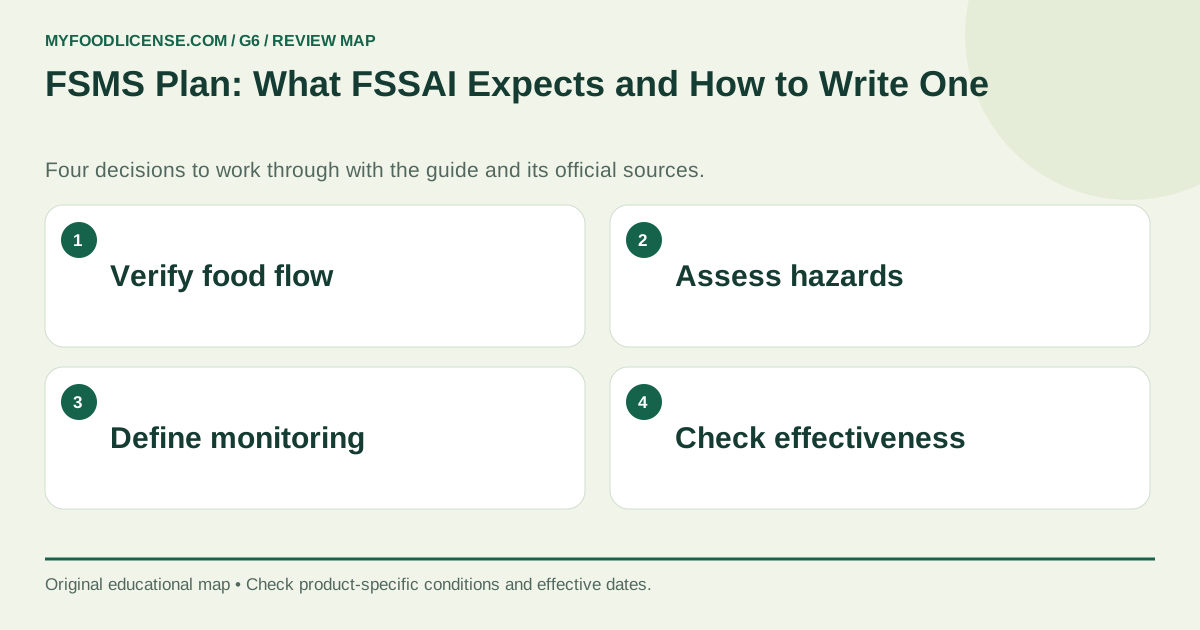
Define scope and process
Record the premises, products, intended use and operations covered. Draw the actual flow from receipt to dispatch and include outsourced steps under the appropriate responsibility. Verify the flow on site rather than copying another business’s diagram.
Build prerequisite controls
Use the relevant Schedule 4 requirements for cleaning, water, pests, maintenance, people, segregation and storage. These basic controls support the hazard assessment. FSSAI’s sector guidance provides practical implementation material and identifies its guidance role. Read FSMS guidance; Schedule 4 basis.
Assess hazards step by step
Consider relevant biological, chemical and physical hazards, including allergens where applicable. Explain the preventive control and why it is suitable. Do not designate every process step a critical control point simply to make the manual appear comprehensive.
Make monitoring actionable
For each material control, state what is checked, by whom, how often, the applicable acceptance basis and what happens after deviation. Retain records linked to the batch or activity. Choose limits supported by the product and process, rather than arbitrary numbers from a template.
Verify and maintain the system
Check whether procedures are followed and controls effective, and review complaints, test results and changes. Distinguish an implemented FSMS from voluntary third-party certification; do not assert universal ISO 22000 certification requirements without an applicable basis. Use CAPA to address failures.
A worked example
Hypothetical example
A kitchen adopts a manual describing retort sterilisation, although it only cooks and delivers fresh meals. It replaces the irrelevant flow with receiving, preparation, cooking, holding, packing and dispatch, and writes controls its staff can actually monitor.
Your practical checklist
- Define products, site and process scope.
- Verify the actual food-flow diagram.
- Establish prerequisite hygiene controls.
- Assess hazards and justified controls.
- Assign monitoring and corrective actions.
- Review effectiveness after changes or failures.
Download this preparation checklist
For help applying this review to your business, explore our FSMS Documentation Support service. Bring the documents described above so the consultation can focus on the decisions still unresolved.
Frequently asked questions
Can I copy another business’s FSMS?
Use relevant structure, but the plan must fit your actual operation.
Is every step a critical control point?
No. Use a justified hazard and control assessment.
Does ISO certification replace daily controls?
No. Implementation and evidence remain essential.
Are all FBOs required to buy the same certificate?
Do not assume universal certification duties; assess applicable requirements.
When should the plan be updated?
After material process, product, premises or risk changes and relevant failures.
Official sources and further reading
Checked on 2 October 2026. Gazette notifications and operative directions prevail over compilations and summaries, including this guide.
- Licensing Regulations compendium, August 2021: Base Schedule 4 structure and licence conditions; old thresholds and validity superseded by 2026 changes.
- Licensing direction of 28 November 2022: Operationalised licensing and Schedule 4 provisions; read with current amendments.
- FSSAI nutraceutical-sector FSMS guidance: Voluntary implementation guidance and practical FSMS principles; not a universal certification mandate.
This guide is general information, not legal advice; the right route depends on your product and business facts. Examples marked hypothetical are illustrations, not client cases. MyFoodLicense is an independent consultancy and is not affiliated with FSSAI; applications are decided by the competent authority on the official FoSCoS portal.