Imported food
Why Imported Food Gets Rejected at the Port (and How to Avoid It)
Imported food can be refused clearance for product, document, label, shelf-life or testing non-conformities. Prevent these through a product-specific pre-dispatch review. If a consignment receives an NCR, read the exact grounds and assess the available route rather than assuming every rejection can be stickered away.
By the MyFoodLicense team Sources checked 3 min read
In this guide
Product permission problems
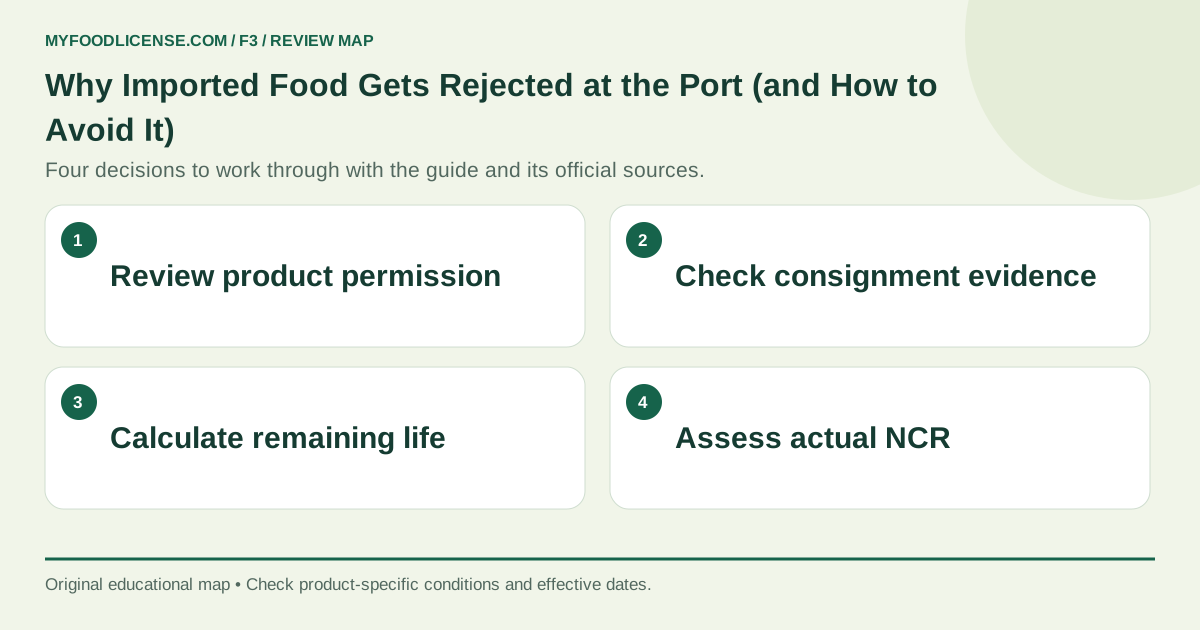
Review ingredients, additives, category and any required approvals. Overseas sale or a foreign certificate does not establish Indian permission. A concentrated botanical, specialised food or additive use may create questions unrelated to the importer’s business licence. Read cross-market permissions.
Documents and label inconsistencies
Mismatched batch, origin, product description or specification can prevent the evidence from establishing the consignment’s position. Label deficiencies have a limited rectification framework. Prepare accurate recipe, specimen artwork and relevant shipment documents before dispatch. Read document and inspection workflow.
Remaining shelf life
The import framework and official FAQ describe remaining shelf life of at least 60% of total shelf life or three months, whichever is less, under the applicable import-date provision. Check the actual dates and rule before shipment. For a hypothetical ten-month product, the lesser period is three months; this arithmetic does not address every category or timing question. Read shelf-life guidance.
Testing and product condition
Damaged packaging, contamination or failure against an applicable analytical criterion need their own assessment. A foreign certificate of analysis is supporting evidence, not a guarantee of Indian clearance. Preserve sample records, reports and relevant storage information when investigating a failure.
Respond to the NCR promptly
Identify whether the issue is document, visual or laboratory-related and read the applicable review or referral route. Preserve the exact communication and dates. Assess re-export, destruction or other disposition under the authorised process; do not release, relabel or reroute rejected stock informally. Read import decision procedures.
A worked example
Hypothetical example
A long-shelf-life snack arrives with two months remaining and the importer cites its original twelve-month shelf life. The review checks the remaining-life requirement and relevant import timing, identifying the issue before treating the original shelf life as sufficient evidence.
Your practical checklist
- Establish Indian product permission.
- Reconcile labels and shipment documents.
- Calculate remaining life on the correct date.
- Review physical condition and test evidence.
- Read and preserve exact NCR grounds.
- Use the authorised review and disposition route.
Download this preparation checklist
For help applying this review to your business, explore our Import Compliance Advisory service. Bring the documents described above so the consultation can focus on the decisions still unresolved.
Frequently asked questions
Does foreign approval guarantee clearance?
No. Indian compliance and consignment assessment remain separate.
Can every rejection be corrected with a sticker?
No. Product, analytical and other defects require different decisions.
What shelf-life formula is cited?
At least 60% of total life or three months, whichever is less, under the applicable import-date rule.
Is a foreign COA enough?
It is supporting evidence, not a clearance guarantee.
Can rejected stock be sold through another channel?
Follow the authorised legal process and disposition; do not informally release it.
Official sources and further reading
Checked on 2 October 2026. Gazette notifications and operative directions prevail over compilations and summaries, including this guide.
- Food Import Regulations compendium, Version III, 12 November 2021: Importer licence and IEC, clearance framework and restricted label rectification. Read with the 2025 amendment and current orders.
- FSSAI Food Imports Manual: Document scrutiny, inspection, sampling, NOC and non-conformance workflow; current Customs/SWIFT implementation may alter screens.
- FSSAI Southern Region food-import FAQs, 15 January 2020: Shelf-life wording and conceptual checklist. Old contact names, fees and portal UI instructions are not carried into the blogs.
This guide is general information, not legal advice; the right route depends on your product and business facts. Examples marked hypothetical are illustrations, not client cases. MyFoodLicense is an independent consultancy and is not affiliated with FSSAI; applications are decided by the competent authority on the official FoSCoS portal.