Claims & advertising
"High Protein", "Low Fat", "Sugar Free": Criteria for Nutrition Claims
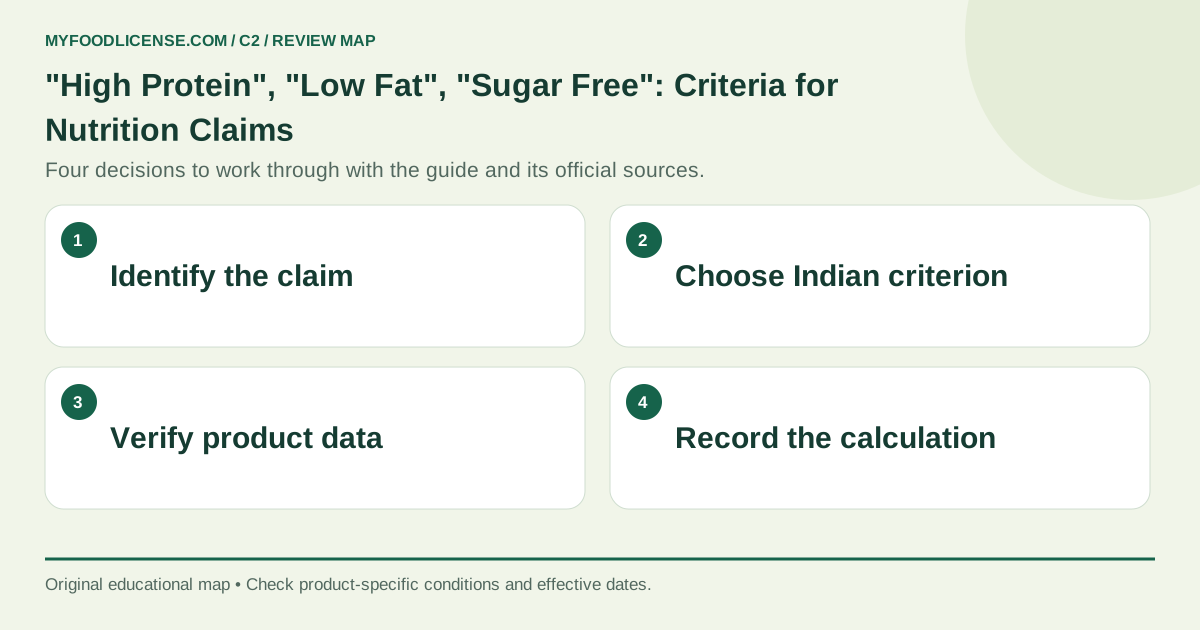
Nutrition claims must meet the Indian criterion for the exact nutrient, food form and reporting basis. Sugar-free and low-fat use defined concentration limits, while high-protein uses specified RDA-based alternatives. Do not copy a foreign claim threshold onto an Indian label.
By the MyFoodLicense team Sources checked 3 min read
In this guide
Start with a claim-specific test
Identify the precise wording, product form, serving and category. The criteria for a conventional food and specialised supplement can differ. Check both the claim rule and the product’s own category requirements. Read Schedule I and related notes.
Common concentration thresholds
| Claim | Solid food | Liquid food |
|---|---|---|
| Sugar-free | Not more than 0.5 g sugars per 100 g | Not more than 0.5 g sugars per 100 ml |
| Low sugar | Not more than 5 g per 100 g | Not more than 2.5 g per 100 ml |
| Low fat | Not more than 3 g fat per 100 g | Not more than 1.5 g fat per 100 ml |
| Fat-free | Not more than 0.5 g per 100 g | Not more than 0.5 g per 100 ml |
Apply the exact criterion and qualifications, rather than rounding a borderline analytical value down to fit the claim.
High protein has an Indian RDA basis
The cited high/rich protein criterion provides alternatives: 20% RDA per 100 g of solid food, 10% per 100 ml of liquid food, 10% per 100 kcal or 20% per serving. These are not a universal rule that 20% of energy must come from protein. Record the selected permissible basis and reference value before calculating.
Evidence must reflect the sold product
Review the current recipe, appropriate test evidence, manufacturing variation and shelf-life behaviour. Check whether preparation changes the reporting basis. A supplier’s protein percentage does not establish the finished snack’s claim, and a small serving should not be chosen solely to manipulate presentation.
Align label and advertising
Declare claimed nutrients as required and use consistent wording on the pack and online. A compliant concentration claim does not authorise a disease or therapeutic message. Keep the calculation, reports and approved copy in the file. Distinguish nutrition and health claims.
A worked example
Hypothetical example
A beverage contains 0.8 g sugars per 100 ml. It does not meet the cited sugar-free concentration limit, even if a tiny serving provides very little sugar. The team reviews alternative accurate wording instead of treating zero added sugar as evidence of sugar-free status.
Your practical checklist
- Identify exact claim and food category.
- Select the correct form and criterion.
- Record units and any RDA basis.
- Use current finished-product evidence.
- Review borderline values and variation.
- Align declarations and advertising.
Download this preparation checklist
For help applying this review to your business, explore our Nutrition Claim Review service. Bring the documents described above so the consultation can focus on the decisions still unresolved.
Frequently asked questions
Is high protein based on 20% energy in India?
The cited Indian criterion uses specified RDA-based alternatives; do not substitute a foreign energy rule.
Can low sugar mean sugar-free?
No. The concentration criteria differ.
Does no added sugar prove sugar-free?
No. Naturally present sugars still count for the sugar-free concentration assessment.
Can I use a raw-material report?
It is supporting input evidence, not a complete finished-product claim assessment.
Do supplement claims use the same table automatically?
No. Check the specialised category and relevant regulatory notes.
Official sources and further reading
Checked on 2 October 2026. Gazette notifications and operative directions prevail over compilations and summaries, including this guide.
- Advertising and Claims Regulations compendium, Version IV, 14 December 2022: Nutrition-claim thresholds and general claim conditions. Protein uses RDA-based alternatives, not a universal percentage-of-energy rule.
- Labelling and Display Regulations compendium, Version VIII, 9 September 2025: Regulation 5: retail declarations, nutrition, dates and allergens. Read alongside later amendments and directions.
- FSSAI RDA 2020 compliance direction, July 2023: Age and nutrient reference tables; distinguish nutritional content from raw compound mass.
This guide is general information, not legal advice; the right route depends on your product and business facts. Examples marked hypothetical are illustrations, not client cases. MyFoodLicense is an independent consultancy and is not affiliated with FSSAI; applications are decided by the competent authority on the official FoSCoS portal.