Claims & advertising
Nutrition Claims vs Health Claims: The Difference and Why It Matters
A nutrition claim describes a nutrient level or comparison; a health claim links a food or constituent to health. The distinction changes the criteria and evidence needed. Neither category should be used to present an ordinary food as a treatment for disease.
By the MyFoodLicense team Sources checked 3 min read
In this guide
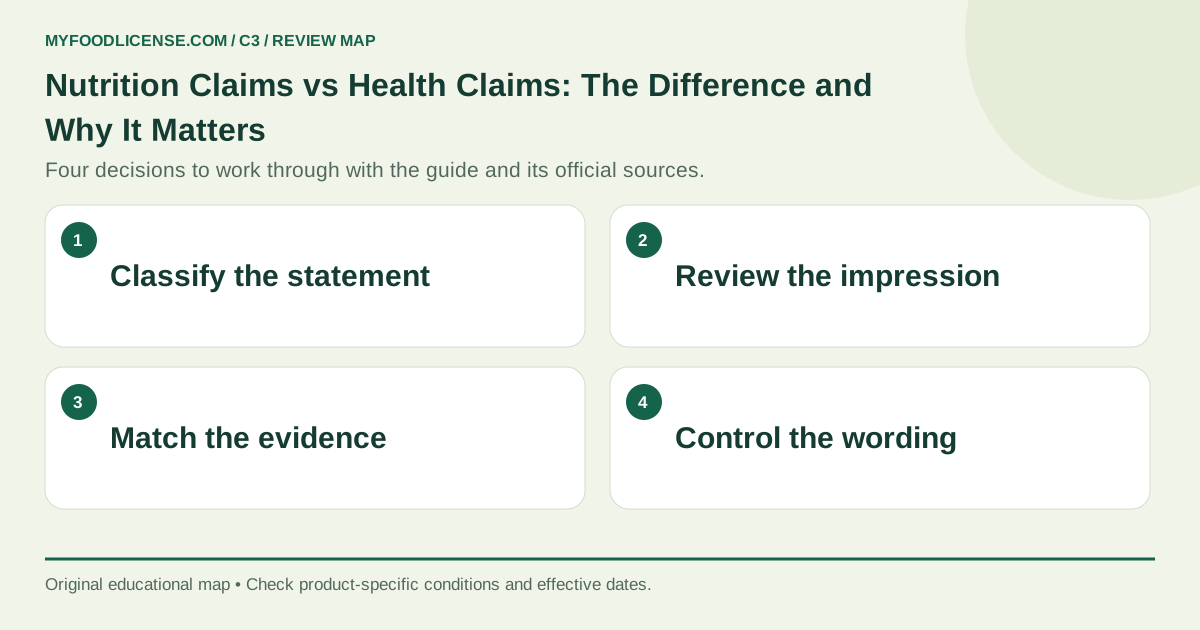
Classify the sentence, not just the headline
| Example wording | Question to assess |
|---|---|
| High in protein | Does it meet the applicable nutrient-content criterion? |
| Less sugar than the reference food | Does the comparison meet the relevant conditions? |
| A statement about normal physiological function | Does it fit an allowed health-claim route and supporting evidence? |
| Treats diabetes | Does it improperly represent a food as treating disease? |
These are classification prompts, not approved claims for a particular product. Read the claim definitions.
Review the full consumer impression
A pack can imply a benefit through pictures, product names and testimonials even when the nutrient statement is accurate. Examine the complete label, website and campaign together. Removing one verb does not necessarily remove a therapeutic implication.
Choose the appropriate evidence
A concentration claim needs suitable product data and the criterion calculation. A function or health claim can require scientific evidence relevant to the substance, dose, food and intended population. Product-led claims and claims requiring prior approval need their specific route. Current approval-submission framework.
Keep conditions with the wording
Where a permitted claim has conditions of use, population or qualifying information, preserve them in the approved-copy record. Do not shorten an assessed sentence until its necessary context disappears. Advertising space limits are a design constraint, not a reason to discard regulatory conditions.
Control all variants
Maintain a claims register showing category, exact wording, source, evidence and status. Give designers and marketing teams the approved versions. A nutrition claim used on the pack should not become a disease promise in an influencer script. Review influencer communication.
A worked example
Hypothetical example
A cereal brand can support a qualifying protein content statement but proposes a campaign promising immunity against infection. The second representation introduces a health and therapeutic assessment that the nutrient calculation alone cannot resolve.
Your practical checklist
- Record the full proposed sentence.
- Classify content, comparison or health representation.
- Assess the complete consumer impression.
- Match evidence to the claim route.
- Preserve required conditions and context.
- Control approved wording across channels.
Download this preparation checklist
For help applying this review to your business, explore our Health Claim Review service. Bring the documents described above so the consultation can focus on the decisions still unresolved.
Frequently asked questions
Is high protein a health claim?
It is ordinarily a nutrient-content claim, subject to the applicable criterion.
Can images create a claim?
Yes. Review the overall presentation and implied message.
Does a lab report support every health claim?
No. The evidence must match the specific claimed effect and conditions.
Can a food claim to cure disease?
Ordinary food representations must not become prohibited treatment or cure claims.
Do some claims need prior approval?
Yes. Assess the specific route and current ePAAS submission requirements.
Official sources and further reading
Checked on 2 October 2026. Gazette notifications and operative directions prevail over compilations and summaries, including this guide.
- Advertising and Claims Regulations compendium, Version IV, 14 December 2022: Nutrition-claim thresholds and general claim conditions. Protein uses RDA-based alternatives, not a universal percentage-of-energy rule.
- FSSAI order of 6 May 2026: ePAAS single-window approvals: Exclusive ePAAS submission from 1 June 2026 for specified approval and notification routes.
This guide is general information, not legal advice; the right route depends on your product and business facts. Examples marked hypothetical are illustrations, not client cases. MyFoodLicense is an independent consultancy and is not affiliated with FSSAI; applications are decided by the competent authority on the official FoSCoS portal.