Supplements & nutraceuticals
Claims for Supplements: What's Allowed
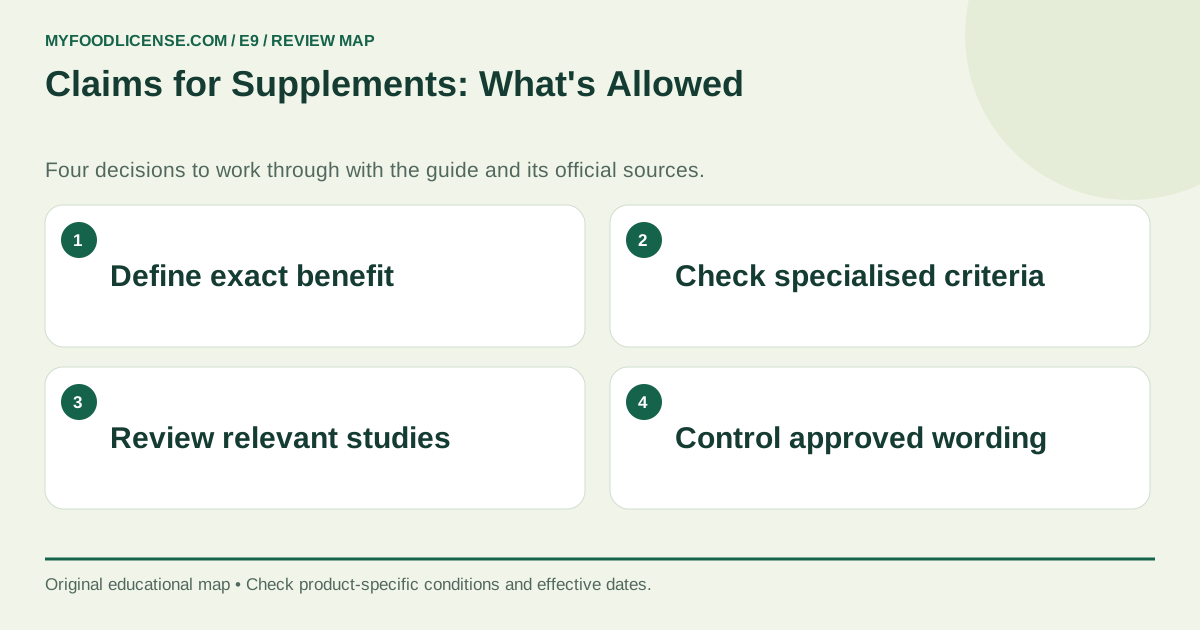
Supplement claims must fit the product category, ingredients, daily dose, intended users and relevant evidence. Permission to use an ingredient is not permission to advertise every benefit. Check specialised provisions together with the Advertising and Claims framework and any approval requirement.
By the MyFoodLicense team Sources checked 2 min read
In this guide
Record the exact proposed message
Capture front-panel statements, brand implications, website text, influencer scripts and testimonials. Identify the claimed effect, audience and duration. Words such as supports, boosts or manages can carry different meanings in context; softer phrasing alone does not make an unsupported message acceptable.
Review the specialised claim position
Supplement provisions contain specific conditions for nutritional and health representations. The Advertising and Claims framework also includes notes relevant to specialised categories. Do not automatically apply every ordinary-food nutrient threshold without checking the category. Read specialised provisions; read claims rules.
Match evidence to ingredient, dose and product
Evaluate scientific quality, population, actual material, exposure and outcome. A study on another botanical extract or probiotic strain may not support the product being sold. Record limitations and relevant conditions rather than selecting only favourable sentences.
Identify prior approval or notification
The ePAAS order covers specified claims and product-related routes, including relevant specialised matters. Establish whether the exact representation needs approval or notification before launch. Submission does not itself establish permission, and an approval for different wording cannot be silently expanded. Read current routing.
Control disease implications and channel changes
Food claims should not become unsupported treatment, cure or prevention representations. A not-for-medicinal-use statement does not neutralise contradictory campaign copy. Give marketing teams approved wording and review translations and testimonial edits. Read influencer controls.
A worked example
Hypothetical example
A botanical blend’s supplier shares a study on one concentrated ingredient. The brand reviews whether that material, dose and effect match the finished blend, and assesses the claim route before using the study in a sales headline. It does not infer a product-wide health promise from an ingredient bibliography.
Your practical checklist
- Record exact wording and implied effects.
- Check category-specific claim provisions.
- Assess ingredient, dose and population relevance.
- Document scientific strengths and limitations.
- Resolve approval or notification requirements.
- Control labels, listings and campaign variants.
Download this preparation checklist
For help applying this review to your business, explore our Claims Assessment service. Bring the documents described above so the consultation can focus on the decisions still unresolved.
Frequently asked questions
Does a permitted ingredient authorise all benefits?
No. Claims need their own assessment.
Can ordinary-food claim tables be used automatically?
Check the specialised notes and category provisions first.
Are testimonials exempt?
No. Review the representations they communicate.
Does dossier submission mean approval?
No. Read the applicable decision and conditions.
Can a warning fix therapeutic advertising?
No. Contradictory overall representations still need review.
Official sources and further reading
Checked on 2 October 2026. Gazette notifications and operative directions prevail over compilations and summaries, including this guide.
- Operationalised supplement provisions, 29 March 2022 direction: Definitions, schedules, dosage, category-specific warnings and product requirements; read with later directions.
- Advertising and Claims Regulations compendium, Version IV, 14 December 2022: Nutrition-claim thresholds and general claim conditions. Protein uses RDA-based alternatives, not a universal percentage-of-energy rule.
- FSSAI order of 6 May 2026: ePAAS single-window approvals: Exclusive ePAAS submission from 1 June 2026 for specified approval and notification routes.
This guide is general information, not legal advice; the right route depends on your product and business facts. Examples marked hypothetical are illustrations, not client cases. MyFoodLicense is an independent consultancy and is not affiliated with FSSAI; applications are decided by the competent authority on the official FoSCoS portal.