Classification & formulation
Standardised vs Proprietary Food: What's the Difference?
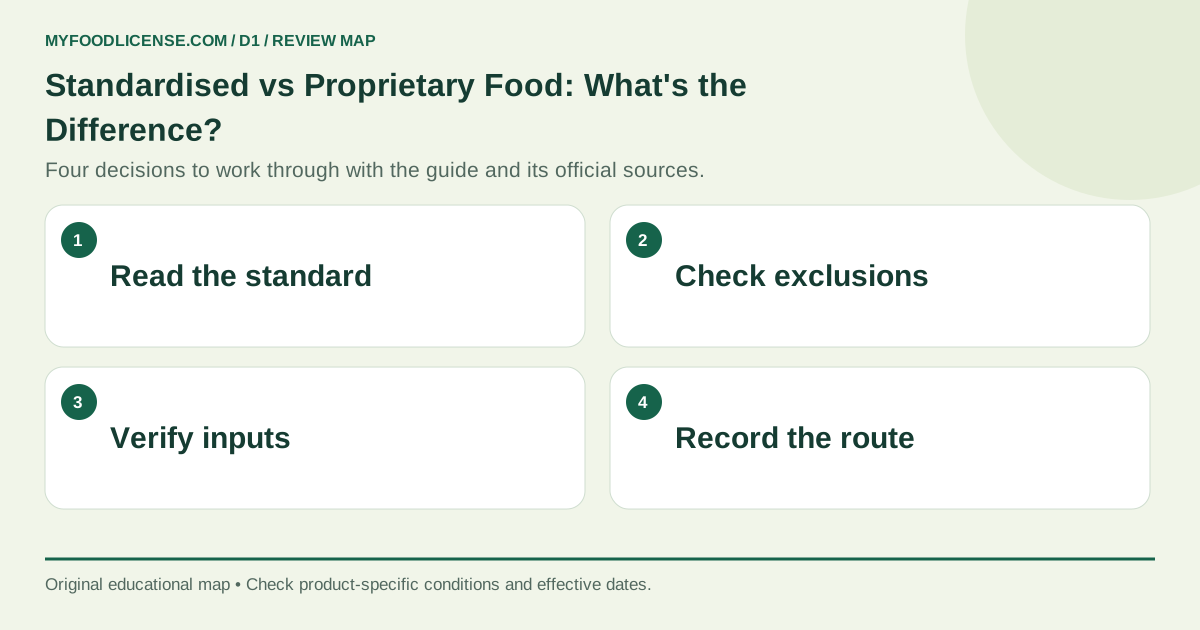
A standardised food must meet the applicable prescribed standard. Proprietary food is a defined route for eligible foods without a specific standard, subject to ingredient, additive and other requirements. It is not a fallback category for a standardised product that fails a quality parameter.
By the MyFoodLicense team Sources checked 2 min read
In this guide
- Compare the whole product with the standard
- Apply the proprietary definition and exclusions
- Review ingredients and additives independently
- Do not relabel a failed standard as proprietary
- Connect classification to the launch
- A worked example
- Your practical checklist
- Frequently asked questions
- Official sources
Compare the whole product with the standard
Read the definition, composition, process and quality requirements for the proposed food. A similar marketing name or category code does not prove compliance. Record which provisions apply and the evidence that the formula and product meet them.
Apply the proprietary definition and exclusions
Regulation 2.12 excludes specified specialised categories, including relevant supplements, nutraceuticals, FSDU, FSMP and novel foods. Establish whether the product actually fits the proprietary route before selecting it in a licensing application. Read regulation 2.12.
Review ingredients and additives independently
The proprietary route has conditions for eligible ingredients and category-based additive permissions. It does not allow any globally available ingredient or unrestricted additive use. Link each input and dose to its legal basis, then assess microbiological and other applicable requirements.
Do not relabel a failed standard as proprietary
The regulation expressly addresses failure to meet quality parameters of a standardised food. Renaming or changing a portal selection does not necessarily remove the applicable standard. Decide whether reformulation is needed before treating a category change as the solution. Read reformulation guidance.
Connect classification to the launch
Record the classification decision, suitable food name, label requirements and licensing consequences. The 2026 table gives proprietary-food manufacturing a Central route irrespective of turnover. Product eligibility and business licensing therefore need linked but separate decisions. Current licensing table.
A worked example
Hypothetical example
A dairy-style product does not meet a required parameter of the standard its identity invokes. The team assesses reformulation and naming instead of simply selecting proprietary. The classification file explains the actual product and applicable rules.
Your practical checklist
- Identify the exact proposed food.
- Compare all applicable standard requirements.
- Check proprietary exclusions.
- Establish ingredient and additive permissions.
- Resolve failed-standard issues.
- Record naming, labelling and licence consequences.
Download this preparation checklist
For help applying this review to your business, explore our Proprietary Food Assessment service. Bring the documents described above so the consultation can focus on the decisions still unresolved.
Frequently asked questions
Is proprietary an approval for any recipe?
No. It is a defined route with conditions and exclusions.
Can a failed standard be avoided by renaming?
Not automatically. Read the standard and proprietary prohibition.
Are supplements ordinary proprietary food?
The definition excludes relevant specialised categories.
Does a category code prove compliance?
No. Recipe and product requirements remain separate.
Does classification affect the licence?
Yes. Special product routes can change eligibility requirements.
Official sources and further reading
Checked on 2 October 2026. Gazette notifications and operative directions prevail over compilations and summaries, including this guide.
- Food Products Standards and Food Additives: regulation 2.12, Proprietary Food: Definition, exclusions, permitted ingredients, additive categories and the prohibition on treating a failed standardized product as proprietary.
- FoSCoS revised Kind-of-Business eligibility table, 2 April 2026 file: Activity-specific eligibility and annual fees. The PDF itself is marked updated 1 April 2026; relevant rows appear on pages 3, 6, 7 and 9.
This guide is general information, not legal advice; the right route depends on your product and business facts. Examples marked hypothetical are illustrations, not client cases. MyFoodLicense is an independent consultancy and is not affiliated with FSSAI; applications are decided by the competent authority on the official FoSCoS portal.